Discover Parks & Wildlife contains affiliate links and is a member of the Amazon Services LLC Associates Program. If you make a purchase using one of the Amazon links, we may receive compensation at no extra cost to you. We may also use select AI tools to support our creative process, but all content is reviewed, refined, and finalized by our human team. See our disclosure policy and our AI use policy for more information.
11 Places That Could Be Straight Out Of A Post-Apocalyptic World
The world is full of landscapes that don’t seem to care about comforting our senses. In fact, some feel so out of this world that you half expect a lone wanderer in tattered clothes to stumble by, clutching a rusty water canteen.
These places stretch across continents, built by wind, salt, and time, yet they whisper the same thing: “This planet has some strange places.” There are deserts that crack underfoot like old bones, valleys carved by ancient oceans, and peaks that jut up like the ruins of something long gone.
Standing in one of these spots, you start to wonder how fragile our modern comforts really are (Wi-Fi, we hardly knew you). They’re raw, rugged, and slightly unsettling.
You don’t come here for palm trees and cocktails. You come because you want to feel small, to see what the Earth looks like when it forgets to be gentle. And each of these places has a quiet power, reminding us that if humanity ever vanished, the planet would keep creating art of its own.
Wadi Rum, Jordan

If Mars ever opens to tourists, it might look a lot like Wadi Rum. This vast desert stretches over 280 square miles of sandstone and granite, painted in shades of rust, rose, and orange. Locals call it the “Valley of the Moon,” and they’re not wrong. It’s cinematic enough to have doubled for Mars in movies like The Martian and Dune.
The towering rock formations here rise hundreds of feet high, their surfaces carved by centuries of sand and wind into delicate curves and impossible cliffs. But despite its harsh beauty, Wadi Rum isn’t lifeless. Bedouin tribes have crossed these sands for generations, leaving petroglyphs that hint at ancient stories of survival.
Nights bring silence so deep you can hear your own heartbeat, and stars spread across the sky in a brightness most of us have forgotten exists. It’s easy to feel like the last person on Earth here… until a camel ambles by with the slow confidence of someone who’s seen it all.
Tsingy De Bemaraha National Park, Madagascar

This isn’t just a landscape; it’s a maze made by nature on a caffeine high. The Tsingy De Bemaraha National Park is famous for its forest of limestone spires, so sharp they could probably slice through a boot if you’re not careful.
Formed by millennia of erosion, these pinnacles rise over 200 feet high, creating an alien skyline that looks more like a fortress than a forest. The Malagasy word “tsingy” translates roughly to “where one cannot walk barefoot,” which feels like an understatement.
Getting around here means crossing rope bridges and squeezing through narrow passages, all while surrounded by razor-edged rock. But in between the stone blades, you’ll find pockets of green. Tiny ecosystems hiding lemurs, reptiles, and rare birds that thrive where few others dare. It’s a reminder that life adapts even in the strangest places.
Goblin Valley State Park, Utah

If you’ve ever wanted to wander through a valley full of mushroom-shaped rock creatures, Goblin Valley is your place. Thousands of sandstone hoodoos (locals call them goblins) dot the desert floor, sculpted by wind and time into strange, rounded figures. Some look like faces frozen mid-grimace; others resemble squat aliens waiting for instructions.
The park spans roughly 10,000 acres in southeastern Utah, with the main Valley of the Goblins area covering about three square miles. The goblins range from knee-height to over 10 feet tall, and the red and brown tones of the rock glow at sunrise, giving everything an almost molten look.
Back in the 1990s, Galaxy Quest filmed scenes here, which makes perfect sense. This is exactly the kind of place where a sci-fi showdown should happen. Bring water and maybe avoid visiting alone at dusk unless you enjoy the feeling of being watched by 5,000 silent stone “faces.”
Craters Of The Moon National Monument, Idaho

Few places in the United States feel as eerily lifeless as Craters of the Moon. This 750,000-acre stretch of Idaho lava fields looks like the aftermath of an intergalactic disaster. The ground ripples with black volcanic rock, broken by cinder cones and deep fissures that vent ghostly heat on cold mornings.
NASA even used it to train Apollo astronauts in the 1960s. Honestly, where else could you find terrain this lunar?
The lava flows here date back between 2,000 and 15,000 years, created by eruptions that left behind miles of twisted basalt. And hiking the trails feels like walking across the cooling surface of another planet. Sparse vegetation clings to the cracks, somehow alive despite the odds.
The Pinnacles, Western Australia

The Pinnacles are what happens when nature experiments with minimalism and menace. Rising from the golden sands of Nambung National Park, thousands of limestone spires jut from the earth like fossilized teeth. Some are just a few feet tall, others tower nearly 12 feet high, shaped over thousands of years by wind and seashell deposits.
It’s a surreal sight, especially at sunrise when the shadows stretch across the dunes. Scientists believe these formations began as tree roots buried in ancient sands, later solidified and exposed by erosion. The result looks like the ruins of some forgotten civilization.
Kangaroos hop between the spires at dusk, and if you are lucky, you might spot an emu strolling past. Visit during the cooler months of May through September if you want to avoid roasting under the Australian sun.
Bisti/De-Na-Zin Wilderness Area, New Mexico

With its cracked earth, stone mushrooms, and twisted rock formations, Bisti/De-Na-Zin looks like a set designer went wild after a long night. Spanning over 45,000 acres in northwestern New Mexico, this badlands area feels frozen in another era.
The name “Bisti” means “among the adobe formations” in Navajo, and that’s exactly what you get: otherworldly shapes that seem alive in the shifting light. And fossils from dinosaurs and ancient reptiles have been found here, which only adds to the eerie atmosphere.
The sandstone and shale formations take on deep oranges, grays, and reds, making sunset feel almost apocalyptic. But the trails are unmarked, so GPS or a sharp sense of direction is essential (this is not the place to test your “wanderlust” instincts).
Atacama Desert, Chile
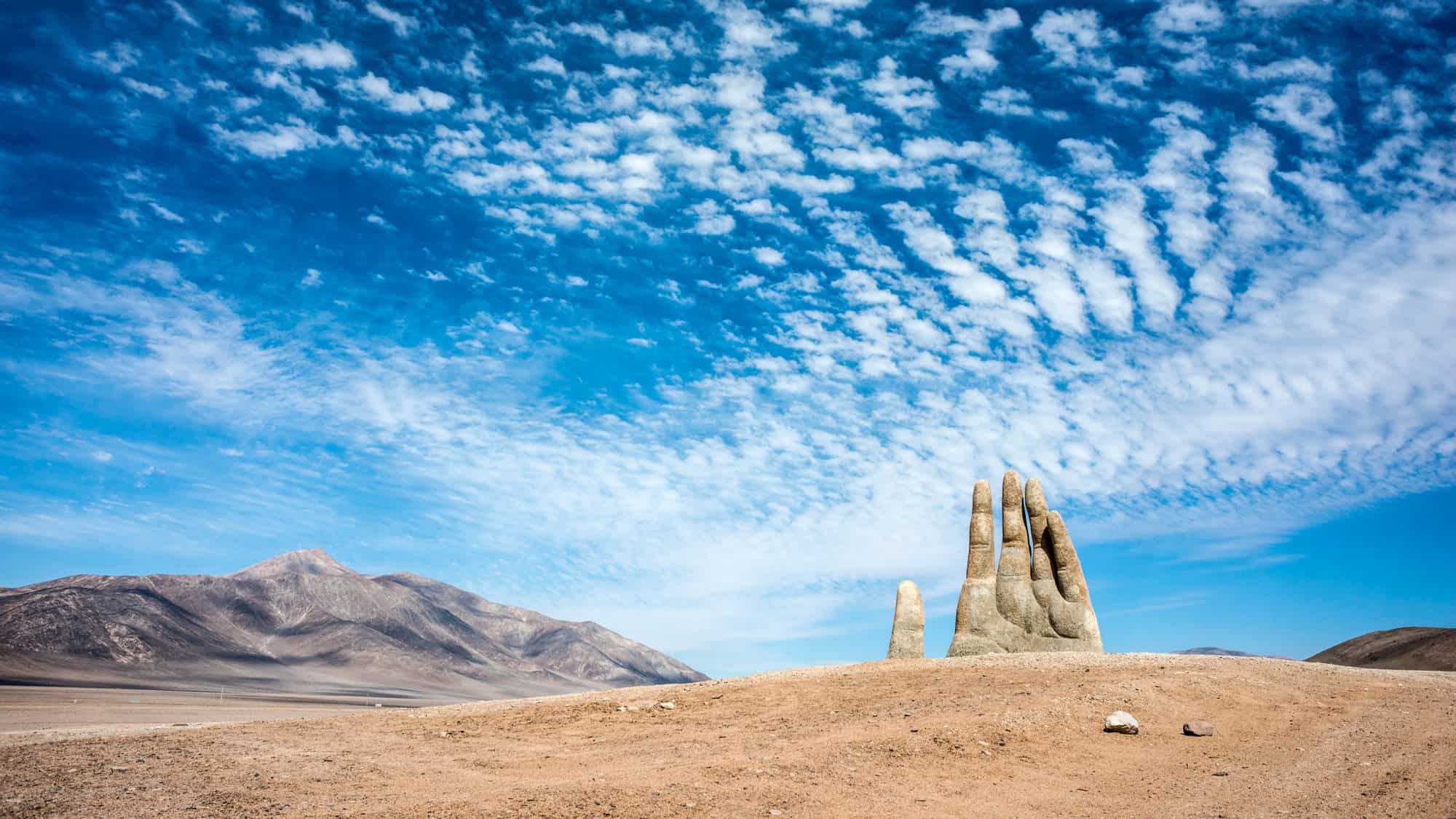
The Atacama Desert doesn’t just look dead; it practically defines dryness. In fact, parts of this 600-mile stretch haven’t seen measurable rain in over 400 years. It’s so arid that NASA uses it to test Mars rovers, which says a lot about what to expect.
The ground cracks into salt flats, and the horizon ripples with mirage-like heat, broken only by distant volcanoes and a few hardy cacti. Yet, despite its lifeless look, the Atacama hides surprising pockets of color and life. Pink flamingos feed in mineral lagoons, and small desert flowers bloom briefly after rare rains.
Nights here are legendary, with some of the clearest skies on Earth for stargazing. And if the apocalypse came and wiped the slate clean, the Atacama might be the last place left untouched… mostly because nothing much can touch it anyway.
Shiprock Peak, New Mexico

Rising 1,583 feet above the desert floor, Shiprock looks less like a mountain and more like the spine of something ancient breaking through the sand. But it’s actually the remains of a volcanic plug, the hardened throat of an ancient volcano that erupted about 30 million years ago.
Sacred to the Navajo Nation, this formation has deep cultural and spiritual meaning. Its Navajo name, Tsé Bitʼaʼi, means “rock with wings.” Climbing is prohibited out of respect for its sacred status, but you can admire it from surrounding roads and trails.
From a distance, Shiprock dominates the horizon. The jagged ridges radiating from its base make it seem alive, like a slumbering creature waiting for the right moment to stir. And at sunset, when the rock turns molten red, it’s easy to see why it feels legendary. This is where myths live on.
Socotra Island, Yemen

Socotra is where evolution got creative and maybe a little weird. Did you know that about a third of its plant species exist nowhere else on Earth? The island’s most famous resident, the Dragon’s Blood Tree, looks like something made up for a science fiction film, with its umbrella-shaped canopy and red sap that really does resemble blood.
Because the island is so isolated (over 200 miles from mainland Yemen), Socotra developed its own ecosystem, complete with rare reptiles and birds that seem to have skipped a few evolutionary memos.
The landscape mixes limestone plateaus, white sand dunes, and turquoise shores, but the overall impression is otherworldly, somewhere between paradise and post-collapse planet. And with tourism limited due to remoteness, this eerie beauty is preserved.
Deadvlei, Namibia
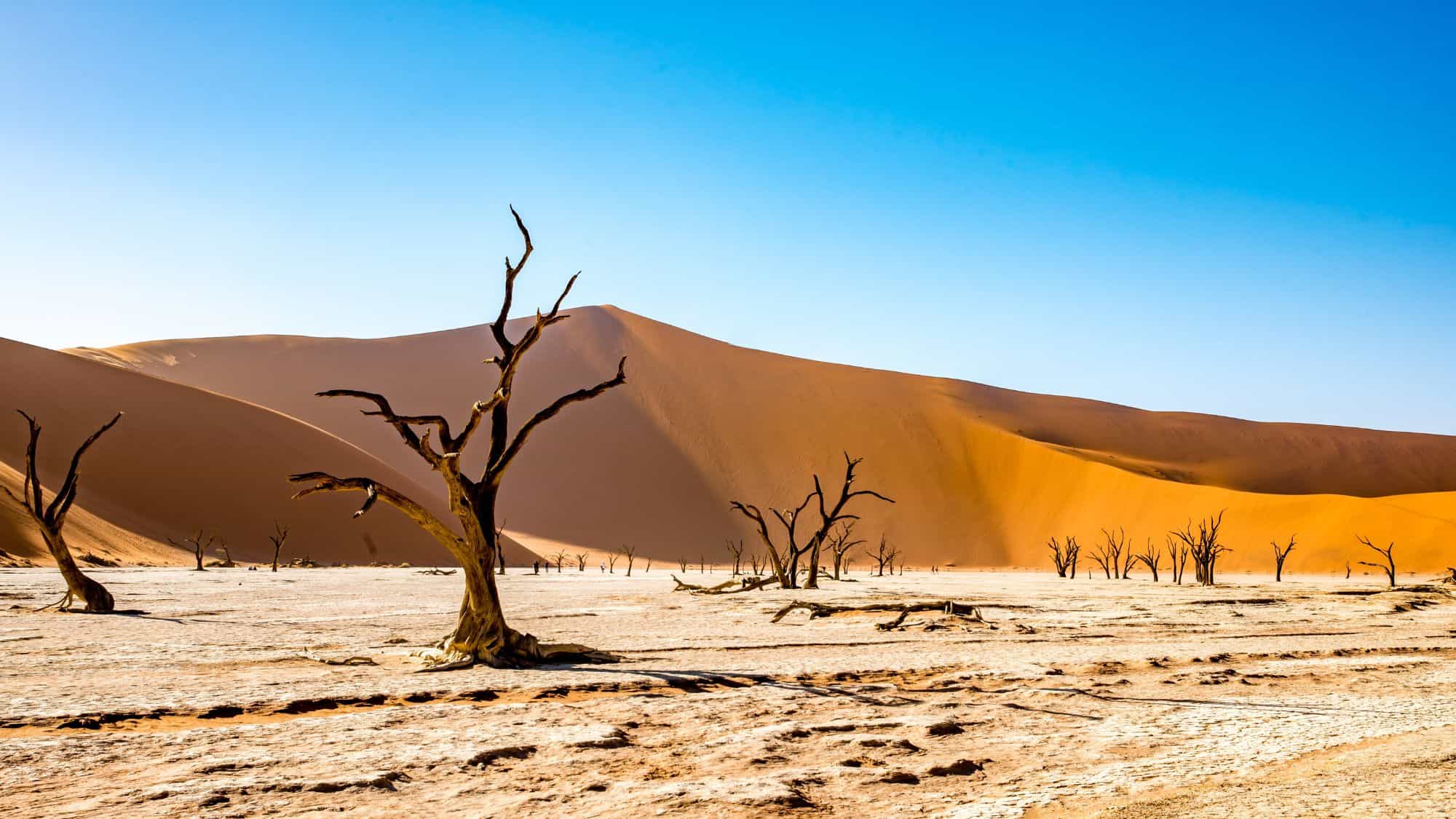
Deadvlei translates to “dead marsh,” and it’s every bit as haunting as the name suggests. Once a thriving oasis fed by the Tsauchab River, the area dried up around 600 years ago when sand dunes cut off its water supply.
What’s left is a flat, white clay pan surrounded by some of the tallest dunes in the world, some reaching nearly 1,100 feet high. The most striking part? The blackened remains of ancient camel thorn trees, long dead but too dry to decompose.
Their silhouettes stand stark against the white ground and orange dunes, creating one of the most photographed scenes in Africa. It’s not a place for lingering, but for marveling as temperatures can soar above 100°F.
Dallol, Ethiopia

If there’s a gateway to another planet on Earth, it might be Dallol. This geothermal field in northern Ethiopia is the hottest inhabited place on the planet, with average annual temperatures hovering around 94°F.
The surface bubbles with sulfur pools, acid ponds, and salt formations glowing in unnatural shades of neon yellow and green. And the air smells faintly of rotten eggs thanks to constant volcanic gases.
Dallol sits within the Danakil Depression, one of the lowest points on Earth at 410 feet below sea level. It’s stunning and dangerous in equal measure, with scientists often comparing it to conditions on Venus. Few living things can survive here, except the occasional extremophile microbe that thrives in acid.
It’s breathtaking, but not exactly comforting… basically, the world’s prettiest nightmare.
Like Our Content? Follow Us on MSN (or click the Follow Button above) for more from Discover Parks & Wildlife.