
Discover Parks & Wildlife contains affiliate links and is a member of the Amazon Services LLC Associates Program. If you make a purchase using one of the Amazon links, we may receive compensation at no extra cost to you. We may also use select AI tools to support our creative process, but all content is reviewed, refined, and finalized by our human team. See our disclosure policy and our AI use policy for more information.
From Sniffing To Survival — These Astonishing Animals Have Nose Superpowers
Most of us stumble through life letting our eyes do all the heavy lifting. We squint at menus, scan for car keys, and generally trust what we see. But out in the wild, sight can be a secondary sense, a luxury not everyone can afford.
For many creatures, the nose is the main event, serving as a high-tech navigation system, a social media platform, and a food delivery app all rolled into one. While we humans are busy trying to figure out what that weird smell in the back of the fridge is, the rest of the animal kingdom is decoding complex messages carried on the wind.
The air is packed with information that we are completely oblivious to, which is a bit humbling when you think about it. Animals use this invisible data to find a mate, dodge becoming a meal, or locate dinner from miles away.
These creatures don’t just smell; they read the environment with a precision that makes our most advanced gadgets look like toys from a cereal box.
From the deep sea to the highest treetops, evolution has produced some truly impressive noses that put our own to shame. Let’s take a look at a few of the extraordinary animals that have some of the best noses around.
African Elephant

You might think an elephant’s most impressive feature is its size or its tusks, but the real party is happening in its trunk. The African elephant holds the record for the most olfactory receptor genes of any mammal, with around 2,000 of them.
To put that into perspective, that’s five times more than us and double the number of a dog, which suddenly makes our sense of smell feel very inadequate.
That trunk isn’t just for show or spraying water on unsuspecting tourists; it’s a finely tuned instrument that can detect water from up to 12 miles away. In the arid landscapes they roam, this skill is less a neat trick and more a crucial survival tool.
These giants also use their sense of smell to keep tabs on family, and it’s way more efficient than a group chat. They can distinguish between the urine of up to 30 different relatives, which is like having a chemical-based social network that tells you who passed by and when.
They can even smell danger by differentiating between the scents of various human groups, knowing which ones historically posed a threat.
Bloodhound

If scent tracking were an Olympic sport, the bloodhound would have a room full of gold medals. These dogs come equipped with up to 300 million scent receptors, making our six million look utterly pathetic.
In fact, their olfactory prowess is so dependable that evidence from a Bloodhound’s trail is admissible in a court of law, which is more than most of us can say for our own testimonies.
A bloodhound doesn’t just smell what’s there now; it smells what was there hours ago. They can follow a trail that is over 300 hours old by picking up on the dead skin cells humans leave behind. While we struggle to notice that the milk has gone bad, these dogs can follow one person’s unique scent across miles of tricky terrain.
They latch onto a smell with the kind of stubborn focus that rivals a toddler who has decided they will only eat beige food. And once a bloodhound is on the case, the world disappears until they find what they are looking for (which is both amazing and slightly terrifying).
People often describe them as a nose with a dog attached, and it’s not an exaggeration.
Great White Shark

We’ve all seen the movies where a shark smells a drop of blood from a mile away, and while there’s some Hollywood exaggeration, the truth is just as impressive.
A great white shark’s olfactory bulb is enormous, taking up a significant portion of its brain, and it allows them to detect one drop of blood in about 25 gallons of water. This skill lets them patrol huge swaths of the ocean, just cruising around waiting for a chemical signal that basically says, “Dinner is ready.”
It’s a terrifyingly efficient system for finding a meal without having to work too hard for it.
Their nostrils, located under their snout, are used exclusively for smelling, not breathing (that’s what gills are for). And water constantly flows through these openings, giving the shark a continuous stream of information about what’s happening around it. They can even follow a scent trail directionally by weaving back and forth to stay inside the scent plume.
So, while you’re out there splashing around, a shark miles away might already have your scent signature logged. It gives a whole new meaning to personal space, doesn’t it? Suddenly, that extra-strong soap doesn’t seem like such a bad idea.
Grizzly Bear

You should never, ever challenge a grizzly bear to a game of hide-and-seek. You will lose.
These absolute units of the forest have a sense of smell that is seven times better than a bloodhound’s, which is frankly just showing off at this point. They can detect a food source, like a carcass or your poorly sealed trail mix, from up to 20 miles away.
The scent-detecting membrane inside their nose is a hundred times larger than ours. This means if you even think about opening a bag of chips in their territory, they already know (which is why I’m scared to even carry a granola bar in bear country).
During mating season, a male grizzly can follow the scent of a female across entire mountain ranges, proving that romance can indeed conquer distance. This olfactory superpower is also critical for their survival, especially when they need to bulk up for winter hibernation.
The thought of an animal smelling you long before you could possibly see it is quite intimidating. It’s also why you’re supposed to make noise in bear country. You don’t want to startle a creature that’s been tracking your lunch for the last five miles.
Domestic Cat

That fluffy loaf sitting on your sofa is hiding a secret sensory weapon. Cats have a special Jacobson’s organ on the roof of their mouth, which allows them to essentially “taste” smells.
If you’ve ever seen your cat sniff something and then make a weird, scrunched-up face, they’re not judging your life choices (well, maybe a little). They’re using the Flehmen response to pull scents into this organ for a more detailed analysis, especially of pheromones left by other cats. It’s like getting a high-definition report on the neighborhood gossip.
With around 200 million odor-sensitive cells in their noses, cats are far superior smellers than most dog breeds. And they use this ability to navigate their territory and leave passive-aggressive notes for other felines.
This is why they rub their cheeks on everything, including you, your laptop, and that clean pile of laundry. They’re marking you as their property.
While you think you run the house, the chemical signals all over your furniture clearly state that the cat is the landlord, and you are merely the can-opening, lap-providing staff. It’s a tough pill to swallow, but the rent is cheap.
Silkworm Moth

The male silkworm moth is the ultimate hopeless romantic of the insect world, and his entire life is guided by his nose.
His feathery antennae are covered in thousands of sensory hairs designed for one thing only: to detect the specific pheromone of a female moth. He can pick up on a single molecule of her scent from nearly seven miles away.
That level of sensitivity is completely unmatched in our world. He doesn’t need a dating app or a pickup line; he just needs one whiff, and the chase is on.
Once he catches that scent, he flies upwind with a single-minded determination that is truly something to behold. He ignores food, danger, and the need for sleep, all in pursuit of his potential mate. His entire adult life, which is very short, is dedicated to this one olfactory mission.
If humans had this kind of unwavering focus, we’d probably have finished all our home improvement projects by now. Instead, we get distracted by a notification on our phones.
You have to admire that kind of dedication, even if it is just for finding a date on a Saturday night.
Koala

Koalas may look like they are perpetually napping, but their noses are always on high alert.
These marsupials are notoriously picky eaters, munching almost exclusively on eucalyptus leaves. The catch is that many eucalyptus species are poisonous, and even on the same tree, toxicity levels can vary.
So koalas use their sharp sense of smell to be their own personal food testers, sniffing out the levels of toxins and nutrients in each leaf before taking a bite. This ensures they don’t accidentally poison themselves, which would be a very unfortunate end to lunch.
Their noses are so good in fact, they can detect subtle chemical differences between leaves on the same branch. A koala will sniff a leaf, give it a look of utter disdain, and move on to the next, like a wine snob at a tasting.
This extreme selectiveness is why they require large habitats; they can’t just chow down on any old greenery. It’s a full-time job being that discerning. At the end of the day, their nose is the only thing standing between them and a very bad time, making you wonder if they’re just foodies with extremely high standards.
Boa Constrictor

Snakes taste the air to smell, which is as cool as it is creepy. When a boa constrictor flicks its forked tongue, it’s collecting scent particles from its surroundings.
The fork in the tongue is brilliant, as it allows the snake to tell which side a smell is stronger on, effectively giving it a stereo sense of smell. Then it pulls its tongue back into its mouth and presses it against the Jacobson’s organ, which analyzes the scent data.
This system is so precise that it allows a boa to track prey in complete darkness with terrifying accuracy.
That constant tongue-flicking is a data-gathering mission. If you see a snake doing it rapidly, it has detected something interesting and is trying to get a better read on it. They can follow the chemical trails left by small animals hours after they have passed through the area. It’s a stealthy hunting method that relies on pure chemical analysis instead of speed or brute force.
While we might stumble around in the dark looking for a light switch, the boa is navigating a rich, detailed world of scent. It’s an impressive skill, though one you’d rather not be on the receiving end of.
Turkey Vulture

Most birds have a notoriously poor sense of smell, but the turkey vulture is the weird cousin who breaks all the rules. These scavengers can detect ethyl mercaptan, a gas produced by decaying animals, from thousands of feet in the air. This skill lets them locate food that is completely hidden from sight under a dense forest canopy.
They are one of the few birds that hunt almost entirely by scent. So if you see a group of vultures circling overhead, they’ve likely caught a whiff of something that would make our stomachs turn, and they’re zeroing in on it.
Their ability is so precise that it has been co-opted for industrial use. Since natural gas is odorless, utility companies add that same stinky chemical, ethyl mercaptan, to it as a safety measure.
When there’s a leak in a pipeline, the vultures start circling the area, thinking there’s a free meal below. Engineers can then spot the circling birds and know exactly where to check for a leak. It’s a brilliant, if slightly morbid, collaboration between man and nature.
The vultures get their hopes up, and we avoid an explosion. It’s a win-win (except for the disappointed birds).
Bumblebee

Bees fly around a world filled with flowers, but finding the ones with the best nectar is a competitive business.
Bumblebees use their antennae to smell flowers from a distance, but their talent doesn’t stop there. They can actually tell if another bee has recently visited a flower by smelling the “footprints” it left behind.
If you didn’t know, when bees land, they leave a faint chemical scent, signaling to others that the nectar bar is temporarily closed. This saves them the energy of landing on an empty flower.
This system is incredibly efficient when you have thousands of flowers to check in a single day. It’s like having a real-time inventory of every flower in the garden.
They can also detect the faint electric fields that flowers emit, using their tiny charged body hairs to help guide them in for a landing. It’s a complex, multi-sensory approach to grocery shopping that is truly mind-boggling.
We’re stuck shaking melons at the store to guess if they’re ripe, while bumblebees know the quality of the goods without even touching down. We could really learn a thing or two from them.
Polar Bear
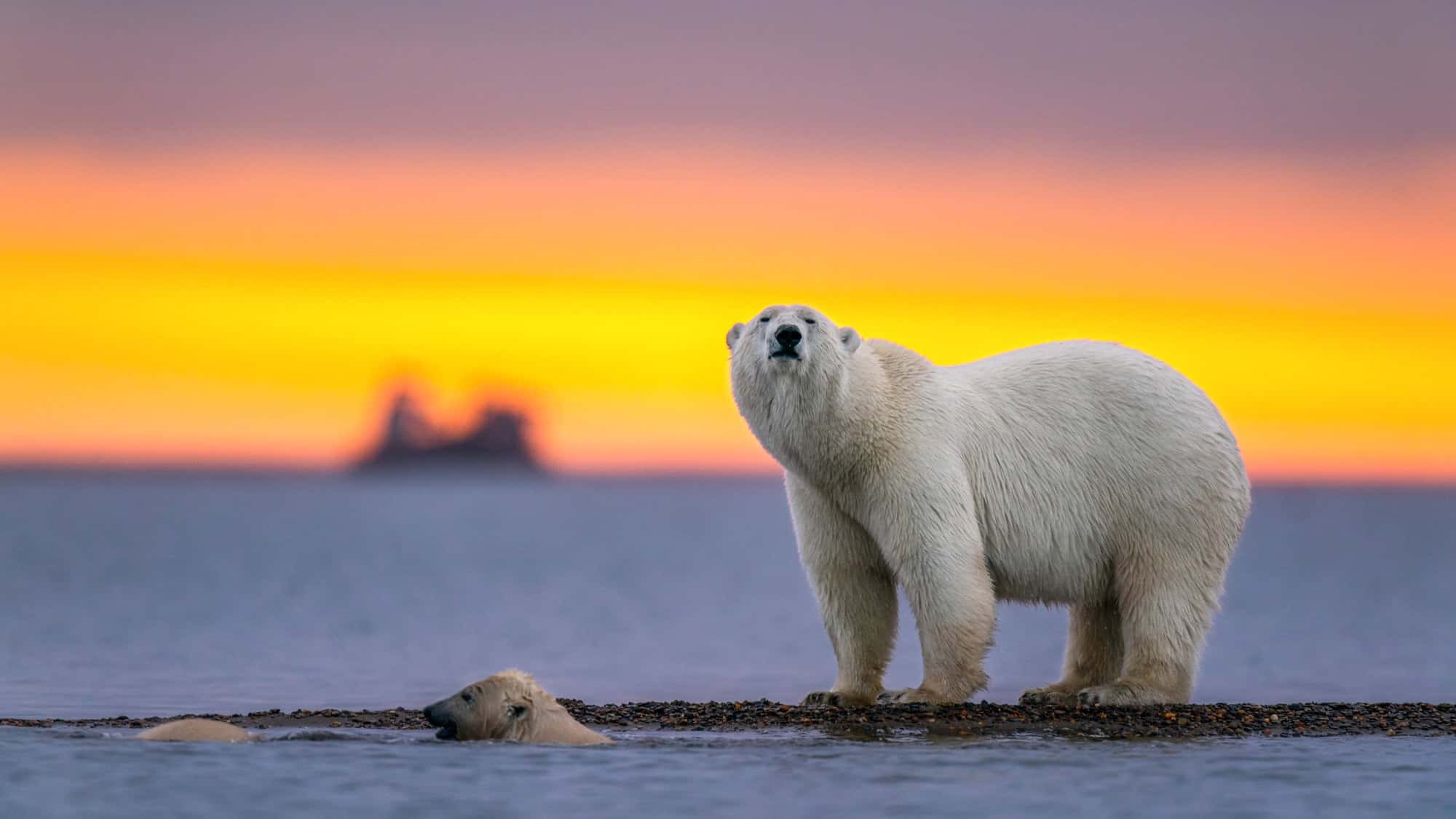
Living in the vast, white expanse of the Arctic means food is scarce and hard to spot. To survive, the polar bear has developed a nose that is basically a long-range homing beacon for seals. They can smell a seal’s breathing hole in the ice from over a mile away.
Even more impressively, they can detect a seal resting on the ice from nearly 20 miles away. And they can even sniff out a seal’s den buried under three feet of solid snow. That’s less a sense of smell and more a form of biological X-ray vision if you ask me.
Their main hunting strategy involves waiting patiently by a breathing hole, a tactic that relies entirely on their nose telling them when a seal is about to surface for air. Without this powerful sniffer, they would starve in the seemingly empty landscape.
They spend their days walking with their noses in the air, reading the wind for the faintest hint of their next meal. It’s a lonely job that depends entirely on that little black nose picking up the scent of dinner drifting across the ice.
It’s a good thing they’re patient, because waiting for a seal to show up sounds like a terrible way to spend an afternoon.
Tiger

Tigers are solitary predators who need a way to tell other tigers to “get off my lawn” without having to get into a fight every day. Their solution is scent marking.
Tigers spray a mixture of urine and glandular secretions on trees and bushes to establish their massive territories. For other tigers, this isn’t just a smelly mess; it’s a detailed social media profile. The scent contains information about the tiger’s gender, reproductive status, and how recently it was in the area.
It’s basically a chemical billboard advertising who’s in charge.
Like their smaller domestic cousins we talked about earlier, tigers also have a Jacobson’s organ. When a tiger makes that funny face by curling its upper lip, it’s using the Flehmen response to get a better read on these scent messages. This helps males find receptive females and allows rivals to steer clear of one another, preventing unnecessary conflict.
In a dense jungle where you can’t see more than a few feet in front of you, a good sense of smell is the primary way tigers maintain a polite, if pungent, social order. It’s a surprisingly civilized system for such fierce animals.
Wolf

Wolves are the ultimate team players, and their noses are a key part of what makes their packs so successful. A wolf can smell its prey from almost two miles away, allowing the pack to coordinate an attack long before the unfortunate animal has any idea it’s being hunted.
But their noses are for more than just finding food. Pack members can identify one another by scent and can even tell the emotional state of a fellow wolf through chemical signals. To a wolf, fear, stress, and aggression all have a distinct smell.
They use urine and scent glands to mark their territory and leave messages for other members of the pack, creating a constant flow of information. When a wolf returns from a hunt, the others will sniff its muzzle to learn where it’s been and what it has eaten, like a furry debriefing session.
For a wolf, it’s physically impossible to keep a secret. Your scent tells your whole story, whether you want it to or not. It would certainly make office politics a lot more straightforward if we had the same ability.
Dolphin

This one feels like a bit of a curveball because dolphins breathe through a blowhole, which is technically their nose. However, toothed whales, including dolphins, have completely lost their sense of smell over evolutionary time.
They have no olfactory bulbs or nerves. But what their “nose” can do is arguably even cooler: echolocation. The blowhole and the air sacs connected to it are used to produce the high-frequency clicks and whistles that allow them to “see” with sound.
They are essentially yelling at their food to find it.
So, while they can’t stop and smell the seaweed, their nasal anatomy has been repurposed into a biological sonar system that would make a submarine jealous. They can locate a fish buried in the sand or tell the difference between two objects of a similar size just by bouncing sound off them.
It was an evolutionary trade-off: lose the ability to smell, gain a superpower. It proves that sometimes, the best thing a nose can do isn’t smell at all, but rather produce loud noises to figure out what’s for lunch.
Horse

Horses are incredibly perceptive creatures, and their nose is a direct hotline to their emotional state. Like cats and tigers, they use the Flehmen response, curling their upper lip in a way that looks quite goofy, to analyze scents with their Jacobson’s organ.
Stallions often do this to check if a mare is ready to mate, but their sense of smell goes far beyond romance. Horses can literally smell fear. When a human is anxious, they release chemical signals that a horse can pick up on instantly.
This is why experienced riders say you can’t fake confidence around a horse; they can smell your anxiety from a mile away.
They also use their sense of smell to recognize friends and differentiate them from strangers. Horses will often greet each other by blowing into one another’s nostrils, a gesture that serves as both a friendly handshake and a security check.
So, if a horse is sniffing your pockets, they might be looking for a carrot, but they’re also gathering intel and deciding if you’re trustworthy. It’s always good to be vetted by the big, hay-eating bouncer.
Rat

Rats often get a bad rap, but they are secretly sensory powerhouses. They can move each of their nostrils independently, giving them a “stereo” sense of smell that allows them to pinpoint the direction of an odor in milliseconds.
Their ability to detect chemical compounds is so acute that they can sense them in parts per trillion. And this incredible skill has been put to lifesaving use by organizations that train “HeroRats” to sniff out landmines. The rats are too light to set off the explosives, but can easily smell the TNT buried underground.
These same rats are also trained to detect tuberculosis in human sputum samples, and they can do it faster and more accurately than some laboratory tests.
They perform these incredible feats for a reward of mashed bananas and avocados, which seems like a pretty good deal. And it’s a powerful reminder not to judge an animal by its reputation.
A rat’s twitching nose is a sophisticated biological instrument that is out there saving human lives. They’re basically tiny, furry superheroes who work for fruit.
Like Our Content? Make sure to join our newsletter for all the latest on outdoor adventures (and a FREE STARGAZING GUIDE). Click here to sign up!