Discover Parks & Wildlife contains affiliate links and is a member of the Amazon Services LLC Associates Program. If you make a purchase using one of the Amazon links, we may receive compensation at no extra cost to you. We may also use select AI tools to support our creative process, but all content is reviewed, refined, and finalized by our human team. See our disclosure policy and our AI use policy for more information.
11 National Parks Where Frozen Waterfalls Become Nature’s Cold-Weather Masterpieces
There’s a quiet magic that settles over the world when winter arrives. It’s a season that takes the thunderous applause of a waterfall and replaces it with a hushed, crystalline silence.
We spend our summers chasing the mist and roar of cascading water, but seeing that same force frozen solid is entirely different. It’s like walking into a gallery where the artist is gravity, and the medium is ice. The water doesn’t just pause; it crafts intricate, gravity-defying sculptures that are unique every single year.
You find yourself staring at colossal icicles hanging from a cliff, pondering how something so immense can just dangle there. It almost makes you take a cautionary step back, just in case physics has decided to take the day off.
Most people tuck their hiking boots away at the first sign of frost, but that’s precisely why you should keep yours by the door. The crowds thin out, the air is crisp, and the landscapes transform into something truly spectacular.
You don’t need to be an elite mountaineer to witness these frozen giants. You just need warm socks and a willingness to feel your nose go numb. It is a special experience to see such a powerful element of nature completely stopped in its tracks.
For those ready to see this quiet spectacle, some places do it better than others. Let’s take a look.
Banff National Park, Canada

If you want to see frozen water without spending days in the backcountry pretending you know how to build a snow cave, Banff is the perfect spot.
Johnston Canyon is the main attraction here, and it’s not shy about showing off. You get to walk along steel catwalks bolted directly into the limestone canyon walls, which feels secure but also just thrilling enough to make you clutch the railing.
The Lower Falls are a lovely appetizer, but the Upper Falls serve the main course. In winter, this 98-foot cascade freezes into a colossal wall of blue ice that climbers love to scale.
Watching them pick their way up the slick surface looks both impressive and utterly terrifying, and it will make you very content with your decision to remain a spectator.
The park service keeps the road to the canyon open year-round, but you will absolutely need ice cleats for your boots. The trail gets polished by thousands of feet until it’s slicker than a politician’s promise.
The round trip to see both falls is about 3.4 miles, leaving you ample time to get back to town and reward your efforts with a glorious plate of poutine.
Plitvice Lakes National Park, Croatia
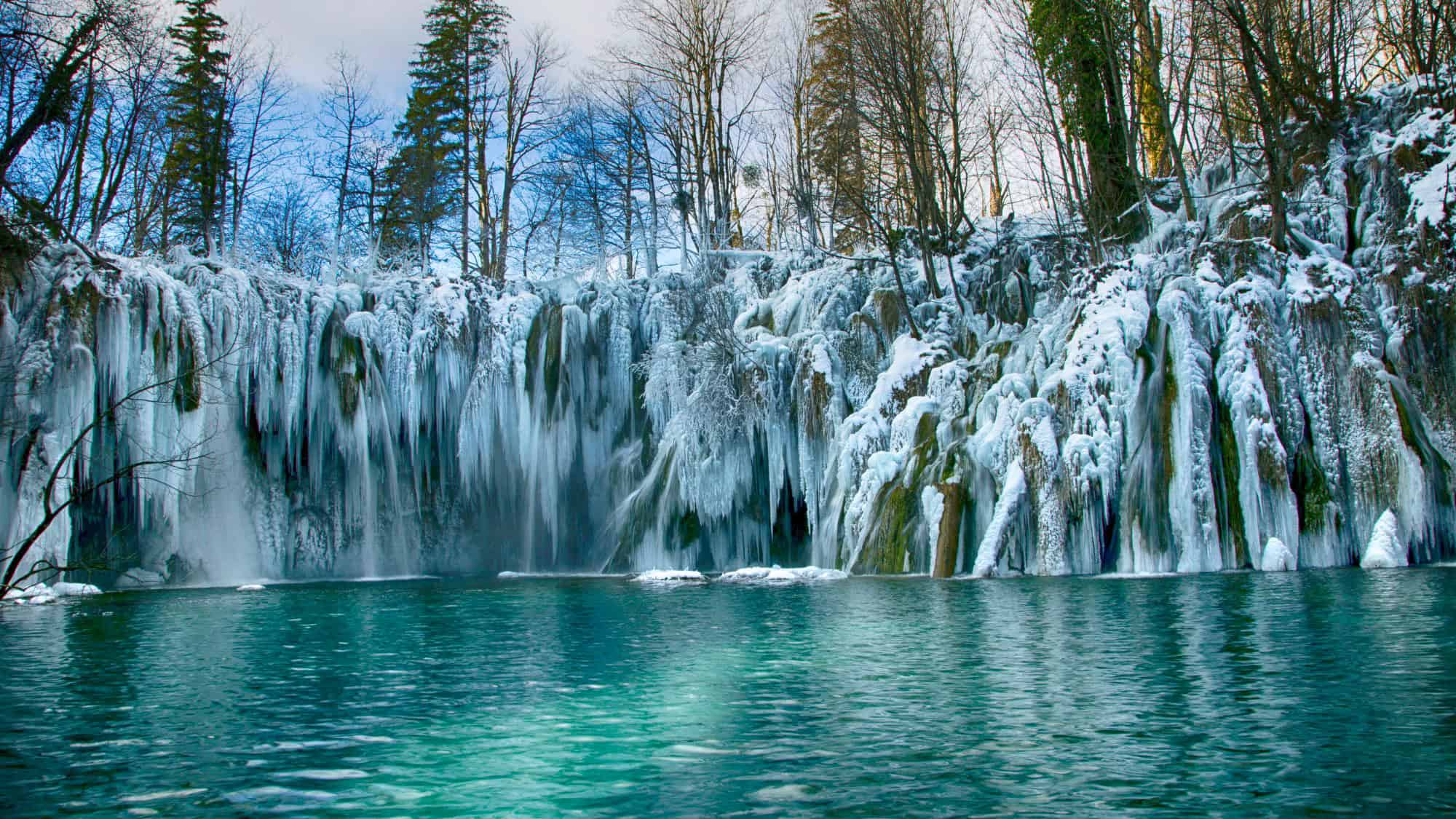
Plitvice is already famous for its terraced lakes and waterfalls that look so vividly blue you suspect someone has been tampering with the water. But in winter, the whole park gets a frosty makeover, turning into a white wonderland where the turquoise water plays peekaboo from beneath blankets of snow.
The park boasts 16 named lakes and more than 90 waterfalls. And while the Upper Lakes often close for safety reasons during winter, the Lower Lakes stay open for business.
This is where you’ll find the Great Waterfall (Veliki Slap), the tallest in Croatia, plunging 256 feet. When the temperatures drop sufficiently, this massive cascade transforms into a breathtaking ice curtain that makes everything else look like a minor water feature.
Just know that navigating the park in winter is a delicate dance. The wooden boardwalks that wind over the lakes become incredibly icy, and many sections lack railings. It adds a certain high-stakes excitement to your otherwise peaceful nature walk.
On the bright side, park entrance fees are much lower in winter, giving your wallet a nice break. It’s cold, slippery, and absolutely worth the risk of an undignified tumble for the incredible views.
Harz National Park, Germany
Deep in northern Germany, Harz National Park is a land of moody forests and old legends about witches gathering on mountain peaks (thankfully, broomstick parking is not an issue for visitors).
The main frozen feature to see is Radau Waterfall. It’s technically an artificial cascade, fed by a river channel that was constructed way back in 1859, but nature has long since taken over.
In the cold months, the water freezes over dark rocks, creating bulky, fantastic ice formations that look a bit like trolls caught in the morning sun. The waterfall drops about 72 feet, which may not be a world record, but it creates a beautiful scene against the dense spruce forest.
The park is also dominated by Brocken, northern Germany’s highest peak at 3,743 feet. And the weather here is notoriously fickle, wrapped in fog for roughly 300 days a year. Getting a clear view of the peak feels like you’ve won the lottery.
You can hike to the waterfall from the town of Bad Harzburg, and the trail is usually manageable. Just be ready for the fog to roll in at a moment’s notice and photobomb your pictures. It’s all part of the charm (or so we tell ourselves).
Vatnajokull National Park, Iceland

Covering almost 14 percent of Iceland, this national park is a ridiculously huge expanse of wild, protected land. And it’s home to Svartifoss, one of the most photogenic waterfalls you could ever hope to see.
Its name means “Black Falls,” a title it earns from the dramatic hexagonal basalt columns that frame it. These dark lava formations resemble a giant’s pipe organ, and in winter, they come draped in shimmering icicles that create a stunning contrast with the black rock.
The waterfall itself is about 65 feet tall. While it’s not the biggest gusher in Iceland, its unique geology makes it look like it was designed by an architect from another planet.
Reaching Svartifoss in winter involves a one-mile uphill hike from the Skaftafell visitor center. The path gets icy (you may be sensing a theme here), and crampons are non-negotiable unless you enjoy sliding backwards down a hill.
Icelandic weather changes every five minutes, so you might start your hike in sunshine and end it in a blizzard. But that just keeps things interesting, to say the least.
Rila National Park, Bulgaria

Rila is the largest national park in Bulgaria and is home to the highest peak in the entire Balkan Peninsula, Musala. But the real winter star is the Skakavitsa Waterfall.
Located at an elevation of around 5,740 feet, it drops 230 feet, making it the highest waterfall in the Rila Mountains. And when winter truly sets in, this cascade freezes solid, turning into a popular destination for ice climbers.
Watching tiny, colorful figures ascend the massive white wall really puts its scale into perspective, and makes you grateful for your warm gloves.
The hike begins near the Panichishte resort area, leading to the Skakavitsa trekking hut in about an hour. From there, it’s a short walk to the falls. Please be aware that this is a proper mountain environment. The area can be prone to avalanches, so always check the local safety reports before heading out.
But standing at the base of that frozen behemoth, with only the sound of the wind in the pines, is a feeling of solitude that’s hard to find anywhere else.
Northeast Greenland National Park, Greenland
Alright, this one is for anyone who thinks Iceland has gotten a bit too mainstream. Northeast Greenland National Park is the world’s largest, covering an area bigger than France and Spain combined, with a human population that you could count on two hands.
It’s the ultimate off-the-grid destination. There are no roads, no hotels, and you generally need a special permit just to get in.
The waterfalls here don’t have trendy names on travel blogs; they are simply unnamed features of the colossal ice sheet’s seasonal melt. And in winter, the entire landscape locks down.
Fjords freeze over, waterfalls become towering pillars of ice, and the only locals you’re likely to encounter are musk oxen or polar bears (it’s best to let them have the right of way).
A visit here requires joining a cruise expedition or chartering a flight, and it’s an adventure for those with deep pockets.
Mount Rainier National Park, Washington

Looming over Seattle like a giant, frosty dessert, Mount Rainier is a true icon of the Pacific Northwest.
In winter, the park gets an absolutely staggering amount of snow. In fact, the main visitor area, Paradise, once set a world record for the most snowfall in a single year, receiving over 93 feet. In fact, the snow gets so deep here that you could be walking over the tops of small trees and not even know it.
Narada Falls is one of the most accessible frozen spectacles in the park. It tumbles 168 feet over a dramatic ledge of andesite rock. During cold spells, the waterfall’s spray freezes onto the surrounding cliffs and trees, creating an ethereal ice palace that looks as if it were sculpted by magic.
The road to Narada Falls is usually plowed, but the park requires all vehicles to carry tire chains.
You can get a decent view from the parking lot, but the real show is at the bottom of the steep trail, which will likely be buried in snow. Snowshoes or traction devices are essential.
Another great spot is Myrtle Falls near Paradise, which offers a perfectly framed view of the mountain. Just remember the gate to Paradise closes each night, so plan your visit accordingly.
Kootenay National Park, Canada

Just west of its more famous neighbor, Banff, Kootenay National Park is often overlooked, which is great news for those of us who prefer our nature with a side of peace and quiet. And the winter highlight here is Marble Canyon.
This limestone gorge, carved by the energetic Tokumm Creek, is a masterpiece when it freezes. The turquoise water turns into brilliant blue ice, creating layers of smooth, frozen waves. You can walk along a fenced trail that crosses several bridges, peering down 120 feet into the icy depths.
The Fireweed Loop Trail offers a short, scenic tour of the area. This part of the park was shaped by a huge forest fire in 2003, and the sight of the stark, blackened trees against the pure white snow is hauntingly beautiful.
The best part? It’s quiet here. You won’t find the bustling crowds of Banff, so you can actually hear the subtle creaks and groans of the shifting ice.
Also, the drive to the park along Highway 93 South is a spectacle in itself, cutting through massive mountain ranges. Keep an eye out for bighorn sheep on the road; they enjoy licking salt off the asphalt (and are completely unimpressed by your car).
Swiss National Park, Switzerland
As Switzerland’s only national park (founded in 1914), this place in the Engadin Valley takes conservation very seriously. You must stay on the trails, you cannot bother the wildlife, and you absolutely cannot bring your dog. Fido will have to sit this one out.
In winter, most of the park is closed to hikers to give the animals a break as they endure the harsh conditions. However, the Pass dal Fuorn road remains open, offering views of frozen cascades tumbling down the mountainsides from the park’s periphery.
The Ova dal Fuorn river also creates beautiful ice formations that are visible from the road and designated viewing areas. While you can’t go trekking deep into the park, the surrounding region offers plenty of its own frozen waterfall adventures.
You can still enjoy the landscape by cross-country skiing on nearby tracks, where you have a better chance of spotting red deer and ibex at lower altitudes.
It’s a different kind of park visit, one focused on observation from the edges. But that makes it feel dignified, respectful, and quintessentially Swiss.
Tatra National Park, Poland & Slovakia

The Tatra Mountains create a stunning natural border between Poland and Slovakia, with national parks on both sides to protect their rugged beauty. In winter, this area is not for the faint of heart.
The most famous destination is Morskie Oko, or “Eye of the Sea,” a mountain lake that freezes completely solid. The trail leading to it passes several waterfalls, including the Wodogrzmoty Mickiewicza.
For a truly massive frozen spectacle, experienced hikers head toward Wielka Siklawa, Poland’s largest waterfall. In the depths of winter, it becomes a gigantic ice slide. Getting there requires proper gear and avalanche awareness, so it’s far from a casual stroll.
On the Slovak side, the Studeny Potok waterfalls are a popular goal for winter hikers. The trails are well-marked, but ice has a way of ignoring signs.
The wind in the Tatras can be ferocious, whipping snow into your face until your eyelashes freeze together (a bold new look). But the mountain huts serve hot tea and soup that will taste better than any five-star meal after a few hours in the cold.
Mount Cook National Park, New Zealand
While the Northern Hemisphere is deep in its winter freeze, New Zealand is typically enjoying summer. But if you visit Aoraki/Mount Cook National Park during their winter, from June to August, you’ll find plenty of icy rewards.
The Hooker Valley Track is the park’s most popular walk, leading you past Mueller Lake to the edge of Hooker Lake. Along the valley walls, small streams freeze into long, delicate icicles that look like white veins tracing paths down the dark rock.
The waterfalls here aren’t massive torrents, but the scenery is simply unbeatable. The sound of distant glaciers cracking, combined with the sight of the frozen cascades, is an experience that stays with you. And you’re walking toward the tallest mountain in New Zealand, Aoraki, with glaciers clinging to its slopes.
The trail is mostly flat and crosses three suspension bridges that can get a bit frosty and wobbly. Especially if someone ahead of you decides to be a kangaroo and test their bounce.
Be aware that the weather is famously unpredictable. It can be sunny one moment and snowing sideways the next. But when the clouds part to reveal the icy peak of Aoraki, standing at 12,218 feet, you won’t give a second thought to your numb fingers.
Like Our Content? Follow Us on MSN (or click the Follow Button above) for more from Discover Parks & Wildlife.