Discover Parks & Wildlife contains affiliate links and is a member of the Amazon Services LLC Associates Program. If you make a purchase using one of the Amazon links, we may receive compensation at no extra cost to you. We may also use select AI tools to support our creative process, but all content is reviewed, refined, and finalized by our human team. See our disclosure policy and our AI use policy for more information.
These 12 National Parks Shine Brightest in March—And Most Travelers Miss This Sweet Spot
March really can feel like the universe’s secret handshake: one short, sweet invitation to see national parks at their most generous. The harshest chills are gone, wild summer crowds are still home learning how bug spray works, and trails seem to roll out the welcome mat just for you.
Flowers start their annual show-and-tell, wildlife is finally awake and hungry (but not for you, don’t worry), and the campgrounds don’t make you enter a lottery or a medieval duel for a decent spot. The sun warms your face enough to make you believe you didn’t forget how to be outdoorsy, but won’t leave you melted in a puddle by noon.
It’s that in-between season sweet spot, where you can pile on layers in the morning and shed them by lunchtime. Rivers are still fresh with mountain snowmelt, forests and canyons are alive with the kind of color and sounds that only show up for those not hibernating indoors.
If there’s a month when the national parks show off and play hard to get, it’s March, tossing you all the benefits and none of the summer chaos. So before the masses wake up and descend with armfuls of selfie sticks, let’s find out which parks shine brightest when March is holding the spotlight.
Arches National Park, Utah

If you have ever tried to hike to Delicate Arch in July, you know it feels less like a majestic communion with nature and more like a survival episode filmed on the surface of the sun. But March changes the game entirely.
The average daytime high sits comfortably around 64°F, meaning you can actually explore the more than 2,000 sandstone arches without risking heatstroke before lunch. You might even still see snow capping on the distant La Sal Mountains, providing a stark white contrast to the rust-red rock that makes your photos look edited even when they aren’t.
Early spring is also when the desert starts to wake up from its winter nap. You might catch the early blooms of wildflowers along the trails, adding pops of purple and yellow to the monochromatic landscape.
Since the timed entry system usually kicks back into high gear in April, a March visit often lets you slide in with a bit more spontaneity (though always check the latest rules because they change faster than fashion trends).
Don’t forget to bring a windbreaker, because when the breeze whistles through those rock windows, it reminds you that the desert doesn’t care about your comfort.
Grand Canyon National Park, Arizona

Most people visualize the Grand Canyon as a baking hot oven, but the South Rim sits at 7,000 feet, which is technically high country. In March, the average high is a brisk 51°F, which is perfect for hiking as long as you keep moving.
The North Rim is still closed for winter, so the South Rim gets all the attention, but the crowds are nothing compared to the summer crush. You can stand at Mather Point and actually see the canyon instead of the back of someone’s head.
The visibility in the cooler months is often superior because the summer haze hasn’t set in yet. This means you can see crisp details across the ten-mile width of the chasm.
If you are feeling ambitious and decide to trek down into the canyon, remember that the temperature rises roughly 5.5 degrees for every 1,000 feet you descend. So you might start in a puffer jacket at the rim and end up in a t-shirt near Indian Garden.
Just watch your step on the upper sections of the Bright Angel Trail, as shaded corners can hide patches of ice that are determined to send you sliding. It adds a little adrenaline spice to your scenic walk.
Petrified Forest National Park, Arizona

This park is severely underrated, mostly because people drive past it on I-40 and think they have seen enough from the highway. They are wrong.
March is a fascinating time here because it is part of the windy season in northern Arizona, with gusts that can occasionally reach 40 to 60 miles per hour. While that sounds intense, it keeps the skies scrubbed clean of clouds, making the colors of the Painted Desert section pop with vibrant bands of red, gray, and lavender.
The temperatures hover in the comfortable 60s°F, making it pleasant to walk the Crystal Forest Trail where massive logs of crystallized wood lie scattered like a giant dropped his firewood. These logs are over 200 million years old, which really puts your daily stress into perspective.
The park is high desert, so while the sun feels warm, the air has a bite that keeps you awake. And it is also one of the few national parks that closes at night, so you can’t linger too long after sunset.
But the stark beauty of the Blue Mesa Trail is best enjoyed when you aren’t sweating through your shirt, and the lack of shade makes the March sun your friend rather than your enemy.
Congaree National Park, South Carolina

Swamps get a bad reputation, but Congaree is here to prove that bottomland hardwood forests can be enchanting rather than terrifying.
The biggest selling point for a March visit is simple: the mosquitoes haven’t fully mobilized their army yet. You can walk the boardwalk loop without needing a transfusion by the time you get back to your car.
The average high temperatures drift into the mid-70s°F, which is practically perfect for paddling a canoe down Cedar Creek to see the bald cypress knees poking out of the water.
If you didn’t know, this park actually protects the largest intact expanse of old-growth bottomland hardwood forest remaining in the southeastern United States. So the trees here are absolute giants, with some reaching heights of over 160 feet, making you feel very small.
It is a quiet park that feels prehistoric. You half expect a dinosaur to wade out from behind a tupelo tree, although you will likely just spot a river otter or a pileated woodpecker.
Virgin Islands National Park, U.S. Virgin Islands

If you are done with the mainland winter and need to thaw out your bones, this is the place.
March is statistically the driest month of the year here, with an average rainfall of just 0.7 inches. While everyone else is dealing with mud season, you could be floating in water that stays a reliable 79°F. And the daily air temperature averages 84°F, which classifies as paradise in my book.
Two-thirds of the island of St. John is national park land, protecting not just the beaches but the history and the reefs. You can snorkel the underwater trail at Trunk Bay and actually see the coral because the lack of rain runoff keeps the water crystal clear.
The park also contains the ruins of 18th-century sugar plantations, which are slowly being reclaimed by the jungle. And hiking the Reef Bay Trail gives you a mix of tropical forest and history, ending at a beach that looks like a screensaver. It is the ultimate reward for walking uphill in the heat.
Please note that island time is real, so don’t expect anything to happen quickly (except for your sunburn).
Bryce Canyon National Park, Utah
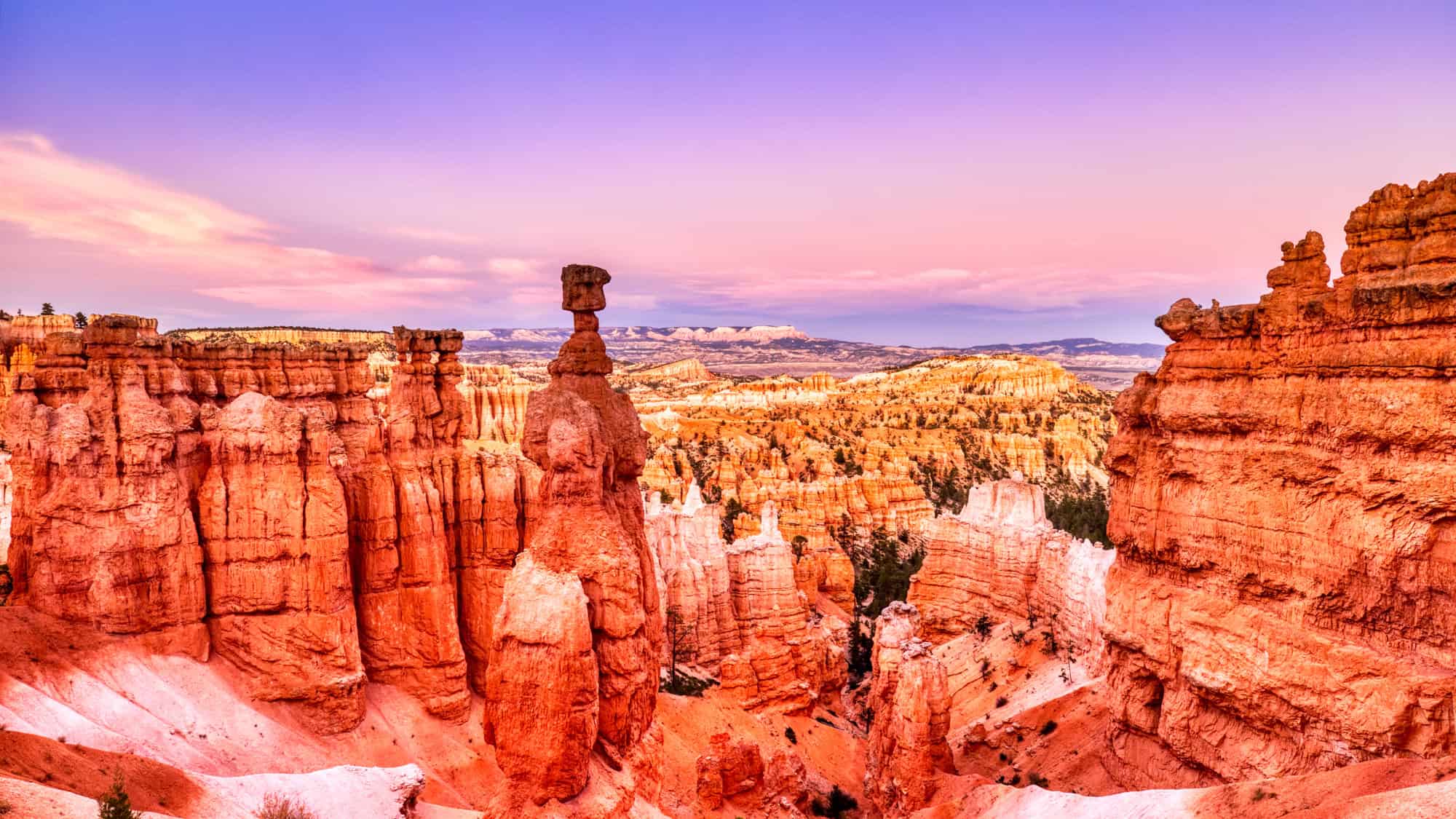
Bryce Canyon in March is visually confusing in the most beautiful way. The famous red hoodoos (those tall, thin spires of rock) are often dusted with bright white snow, creating a contrast that breaks your brain a little.
Since the park sits at a high elevation (up to 9,100 feet), winter hangs on tight. High temperatures average around 45°F, but nights still drop well below freezing, sitting at a chilly 23°F.
The clear, cold air makes for incredible stargazing if you are brave enough to stand outside at night. Bryce is a certified International Dark Sky Park, and the Milky Way puts on a serious show.
During the day, the sun is strong enough to make you feel warm despite the thermometer reading, but as soon as a cloud rolls in, you will be reaching for that beanie. And you absolutely need boots with good traction because the trails can be a mix of mud, ice, and slush.
While this park is on the chillier side still in March, it is a dramatic landscape that feels wilder and more rugged before the summer infrastructure fully wakes up.
Hot Springs National Park, Arkansas

This is possibly the weirdest national park because it is partly an urban street, but that is part of the charm. March brings average highs in the mid-60s°F, which is ideal for strolling down Bathhouse Row without melting into the pavement.
The park protects 47 thermal springs that flow from the mountain slopes, and yes, you can touch the water (but it comes out at 143°F, so maybe don’t hold your hand there too long).
As you stroll down the main street, the historic architecture is stunning, featuring eight bathhouses that were built between the late 19th and early 20th centuries. You can actually book a soak in the Buckstaff Bathhouse, which has been operating continuously since 1912. It is basically a spa day that counts as a national park visit.
The hiking trails behind the row offer nice views of the town and the Ouachita Mountains, which are starting to green up in early spring.
If all that wasn’t enough, it’s also the only national park where you can hike a mountain and then immediately go get a craft beer brewed with thermal spring water across the street.
Big Bend National Park, Texas

Texas is big, and this park proves it by covering over 800,000 acres of Chihuahuan Desert, mountains, and river canyons.
March is arguably the absolute peak time to visit because the bluebonnets (the state flower) often start blooming, turning the roadside into a sea of blue that looks almost fake. The temperatures are still a bit erratic but generally lovely, ranging from the 70s to mid-80s°F down by the Rio Grande, though it can be ten degrees cooler up in the Chisos Mountains.
This is a park of extremes where you can hike the South Rim Trail for alpine views and then drive down to the Santa Elena Canyon to watch the river cut through 1,500-foot limestone walls. And the sheer scale of the place swallows up crowds, so even during spring break, you can find solitude if you walk more than a mile from the trailhead.
Just keep an eye on your gas tank and water supply. The desert does not forgive poor planning, and the “nearby” gas station is never actually nearby.
Everglades National Park, Florida
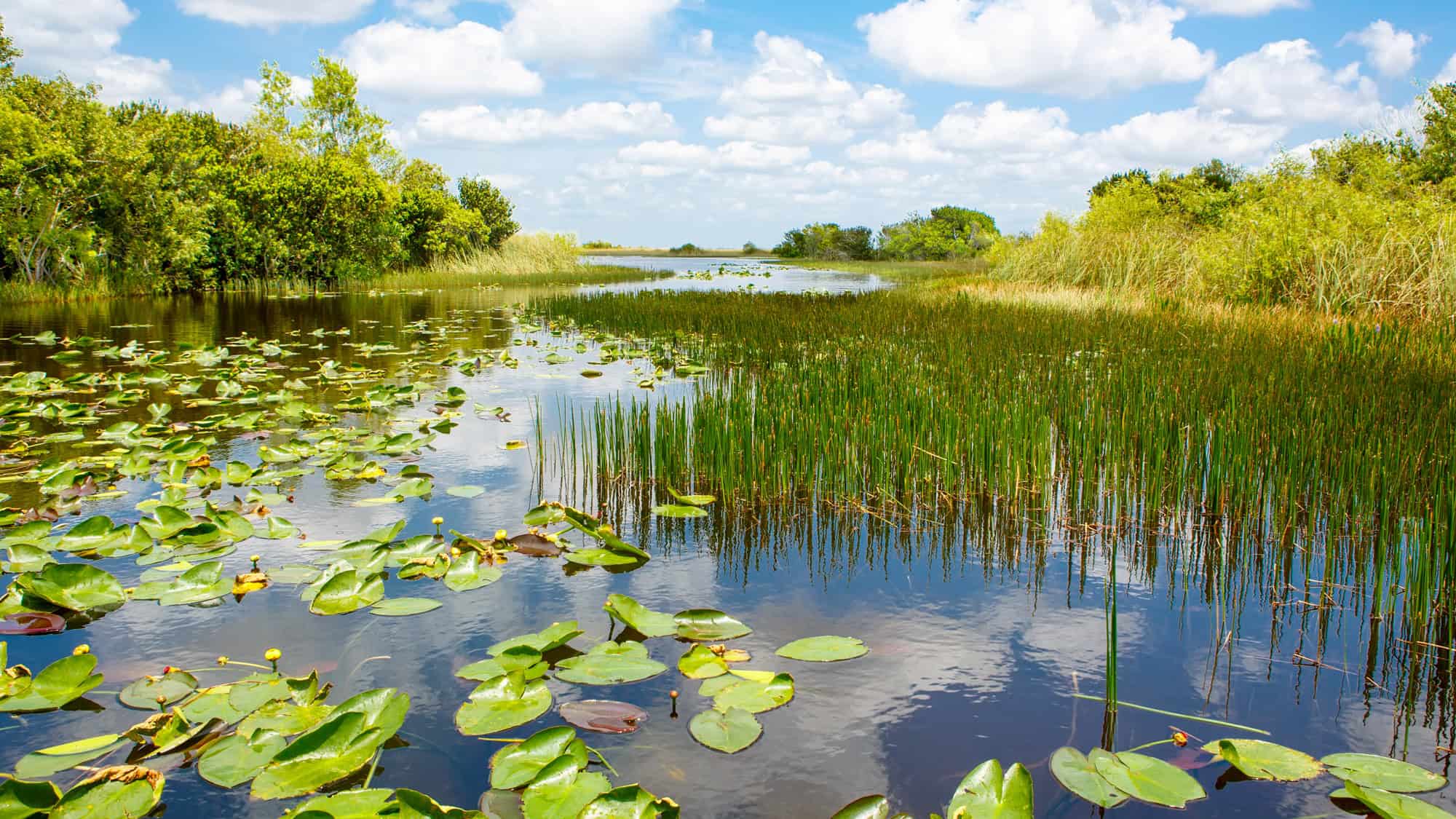
Everglades National Park is a subtle park that requires patience, but in March, nature makes it easy for you. This is the tail end of the dry season, which is critical for wildlife viewing.
As the water levels in the vast wetlands drop, animals are forced to congregate around the remaining deep-water holes. So you can stand on the Anhinga Trail and see dozens of alligators, turtles, and herons all ignoring each other in a muddy pool.
You might even see a manatee in the marina or a crocodile (yes, they have those, too) sunning itself on a boat ramp.
Temperatures hang around the low 80s°F, and while humidity is always a factor in Florida, it hasn’t reached the suffocating levels of summer yet. And the mosquitoes are present, but not yet forming clouds that can carry away small children.
Gateway Arch National Park, Missouri

Some purists argue about whether this should even be a national park, but you can’t deny that the structure is impressive. Standing 630 feet tall, the Arch is the tallest man-made monument in the Western Hemisphere.
March weather in St. Louis can be all over the place, but averages usually land in the mid 40s to 50s°F, which is fine because the main attraction is indoors or inside a tiny tram pod.
The tram ride itself is a retro-futuristic experience where you squeeze into a capsule that feels like a washing machine, but the view from the top is worth the mild claustrophobia.
The park grounds have been revamped recently, connecting the Arch to the city and the Mississippi River waterfront. In March, the grass is returning, and the crowds are thin enough that you might not have to wait hours for the tram ride to the top.
The museum under the Arch is surprisingly deep as well, covering the westward expansion and the engineering behind the monument.
Hawai’i Volcanoes National Park, Hawaii

While the beaches get the glory, the volcanoes bring the drama. This park is actually home to two of the world’s most active volcanoes, and the landscape is constantly changing based on what the lava decides to do that week.
The summit of Kilauea sits at about 4,000 feet, so the temperatures are much cooler than at your resort, usually hovering in the 60s or 70s°F. March can be rainy (it is a rainforest, after all), but the mist adds a Jurassic Park quality to the fern forests and steam vents.
You can walk through the Thurston Lava Tube, which is a massive tunnel formed by flowing lava that drained away 500 years ago. It feels like entering the throat of the earth. And the Chain of Craters Road is a drive that takes you past miles of solidified black lava flows that stop abruptly at the ocean. The contrast of the black rock against the blue Pacific is jarring.
Even if there isn’t active surface lava glowing during your visit, seeing the steam rising from the crater floor is a reminder that the ground beneath you is very much alive and just waiting to remodel the kitchen.
Zion National Park, Utah

Zion is one of the most popular parks in the country, which means summer is a gridlock of shuttles and sweaty hikers. So March is your chance to see the soaring sandstone cliffs with a fraction of the chaos.
The average high is a pleasant 66°F, perfect for tackling the switchbacks up to Scout Lookout. And the shuttle system usually starts running daily in March, which makes getting around easier, though you still need to be strategic about parking.
The Virgin River carves through the canyon, and while hiking the Narrows in March means wearing a dry suit (the water is dangerously cold snowmelt), the main canyon trails are usually clear. You might even spot some waterfalls that dry up later in the year.
Standing at the bottom of the canyon looking up at walls that rise 2,000 feet above you is a humbling experience. It makes you realize that nature is the original architect, and she likes things big, red, and vertical.
Like Our Content? Make sure to join our newsletter for all the latest on outdoor adventures (and a FREE STARGAZING GUIDE). Click here to sign up!