Discover Parks & Wildlife contains affiliate links and is a member of the Amazon Services LLC Associates Program. If you make a purchase using one of the Amazon links, we may receive compensation at no extra cost to you. We may also use select AI tools to support our creative process, but all content is reviewed, refined, and finalized by our human team. See our disclosure policy and our AI use policy for more information.
12 Rare Mammals Lurking in National Parks—You’ll Likely Never See Them
Visiting a national park often involves scanning the horizon for charismatic animals. And most visitors arrive with a mental checklist of ones they hope to encounter. Bison blocking the road or elk grazing in a meadow are common rewards for your patience.
Yet there is a different category of wildlife that defines the true wildness of these protected landscapes. These are the phantoms of the forest and the ghosts of the desert. They are creatures that move in silence, hunt under the cover of darkness, or inhabit terrain so rugged that humans rarely set foot there.
Seeing one of these animals is not just a check on a list. It is a moment of genuine shock and awe.
The animals on this list range from apex predators that deliberately avoid human contact to small mammals that have adapted to live unseen in plain sight.
Some were once extinct in the wild and have been painstakingly brought back. Others have populations so small that researchers spend years trying to document a single individual. And your chances of spotting them are slim.
That rarity is exactly what makes their existence so compelling. Knowing they are out there watching from the treeline or sleeping in a burrow beneath your boots adds a layer of thrill to every hike.
So let’s explore the elusive mammals that call our national parks home.
Canada Lynx – Glacier National Park, Montana

The Canada lynx is often called the shadow of the forest for good reason. This medium-sized cat is a specialist hunter that requires specific conditions to thrive. Glacier National Park provides the deep snow and dense boreal forests that lynx need.
Their massive paws function as natural snowshoes. This adaptation allows them to travel across powder that would trap other predators. They rely almost exclusively on snowshoe hares for food.
This dependency means their populations rise and fall in sync with hare numbers. And the fact is, you might spend a lifetime hiking in Glacier without ever seeing one.
Recent studies using motion-sensitive cameras have given biologists a better understanding of lynx distribution within the park. They have found that these cats inhabit a large portion of the park, even in areas visited by humans.
Yet despite this presence, they remain invisible to the naked eye. They are experts at using cover and camouflage to blend into the gray and white tapestry of a winter forest.
Biologists estimate there are only about fifty individuals in the entire park. This low density, combined with their silent nature, makes a lynx sighting one of the most coveted experiences in the Rockies.
Black-Footed Ferret – Badlands National Park, South Dakota

The black-footed ferret carries a conservation story that borders on the miraculous. This small carnivore was once declared extinct in the wild. Today, thanks to intensive reintroduction efforts, they hunt again in the prairies of Badlands National Park.
These ferrets are strictly nocturnal and live almost entirely underground. They rely on prairie dog burrows for shelter and prairie dogs themselves for food.
A single ferret can consume over one hundred prairie dogs in a year. This specialized diet ties their fate directly to the health of the prairie dog colonies.
Spotting one requires a specific strategy and a lot of luck. Park rangers occasionally lead night surveys where powerful spotlights sweep the darkness. The goal is to catch the distinctive emerald-green eyeshine of a ferret peering out from a burrow.
During the day, they stay hidden deep underground to avoid heat and predators such as eagles or coyotes.
The population in the Conata Basin area of the park is one of the most successful self-sustaining groups in North America. But even with numbers hovering around one hundred and twenty individuals, their subterranean lifestyle keeps them out of sight for the vast majority of visitors.
Mountain Lion – Big Bend National Park, Texas

Big Bend National Park encompasses vast stretches of the Chihuahuan Desert and the rugged Chisos Mountains. This is prime territory for the mountain lion.
Also known as cougars or pumas, these large cats are the park’s top predators. They are solitary animals that patrol immense territories. A male mountain lion might cover a range of dozens of square miles.
They prefer rocky canyons and cliffs where they can ambush prey such as javelina and mule deer. And their tawny coats match the desert soil and limestone rock perfectly, making them nearly impossible to spot for the casual observer.
Biologists estimate that only a couple of dozen mountain lions reside within the park boundaries at any given time. Most visitor reports come from drivers who see a long tail disappearing into the brush as they round a curve.
Hiking encounters are also extremely rare because these cats actively avoid humans. They sense you long before you sense them.
If you are lucky enough to see one, it is crucial to stand your ground and never run. Running can trigger their instinct to chase.
Wolverine – North Cascades National Park, Washington

Few animals embody the spirit of the untamed wilderness quite as well as the wolverine. These stocky members of the weasel family are infamous for their strength and endurance. They inhabit the most forbidding terrain in the Lower 48.
North Cascades National Park offers the high elevation and persistent snowpack that wolverines require for denning, making it a perfect place to live.
Females dig deep into the snow to create secure nurseries for their kits. But this reliance on spring snow cover makes them vulnerable to a warming climate.
Wolverines are scavengers as well as hunters. They will drive bears away from kills and crunch through frozen bone with powerful jaws. But despite their ferocious reputation, they are incredibly elusive.
The Cascades Wolverine Project and other researchers use camera traps and genetic sampling to study them because direct observation is nearly impossible. And there are likely fewer than forty wolverines in the entire Washington Cascades range.
A sighting usually involves spotting a bear-like figure loping across a high alpine snowfield. For the average hiker, the wolverine is a phantom that exists only in tracks left behind on a snowy ridge.
Kit Fox – Death Valley National Park, California

The kit fox is the smallest fox species in North America. It thrives in the harsh environment of Death Valley National Park.
These foxes have evolved oversized ears that serve a dual purpose. The large surface area helps dissipate body heat in the scorching desert summer. They also provide exceptional hearing to locate insects and kangaroo rats scuttling across the sand.
Kit foxes are almost exclusively nocturnal. They spend the blazing daylight hours deep inside underground dens where temperatures remain stable.
Despite living in one of the hottest places on Earth, they rarely drink free-standing water. They obtain almost all the necessary moisture from their prey. This adaptation allows them to survive in areas far from springs or oases.
You are most likely to spot a kit fox near campgrounds or paved roads after the sun goes down. They are curious animals and opportunistic scavengers. Observing a kit fox requires patience and a sharp eye for movement in the beam of your headlights.
Red Fox (Sierra Nevada Subspecies) – Yosemite National Park, California

The Sierra Nevada red fox is a unique subspecies distinct from the common red fox found in lowlands and suburbs. This rare mammal is adapted to the high alpine zones of California.
For nearly a century, biologists believed this fox had vanished from the Yosemite region. Then, in late 2014, a motion-sensitive camera captured an image of one within the park boundaries. This rediscovery sparked a new wave of research and hope.
These foxes sport a coat that can be red, silver, or black. They also have furry toe pads that provide traction on ice and snow. They avoid competition with coyotes by staying in the snowy high country, where their lighter build gives them an advantage.
Finding one is a challenge of altitude and persistence. They inhabit elevations above 6,000 feet and prefer subalpine forests and fell fields. And the population is incredibly small.
Researchers believe there may be fewer than fifty individuals in the entire Sierra Nevada range. So eeeing a Sierra Nevada red fox is a once-in-a-lifetime event. Most park rangers have never encountered one.
They remain one of the most endangered and elusive mammals in the United States.
Abert’s Squirrel – Grand Canyon National Park, Arizona

The Grand Canyon is famous for its geology, but it also serves as a barrier that has shaped the evolution of squirrels. The Abert’s squirrel inhabits the South Rim area of the national park.
This rodent depends entirely on ponderosa pine forests for its survival. The trees provide nesting sites, food, and cover. Abert’s squirrels are easily recognized by their long ear tufts or tassels. These tufts are especially prominent in winter. They have gray bodies, a reddish patch on their back, and a white belly.
While squirrels might seem common, the specific relationship between the Abert’s squirrel and the ponderosa pine makes them a fascinating study in specialization. They eat the inner bark of twigs, the seeds from cones, and even underground fungi associated with the tree roots.
On the North Rim, you find the Kaibab squirrel. This is a subspecies of the Abert’s squirrel that was isolated by the canyon chasm. The Kaibab squirrel has a distinctive all-white tail and a black belly.
Visitors to the South Rim can look for the Abert’s squirrel scurrying along the forest floor. They blend in well with the shadows and pine needles.
Spotting one with full ear tufts is a classic Grand Canyon wildlife moment that requires looking up into the canopy.
Desert Bighorn Sheep – Zion National Park, Utah
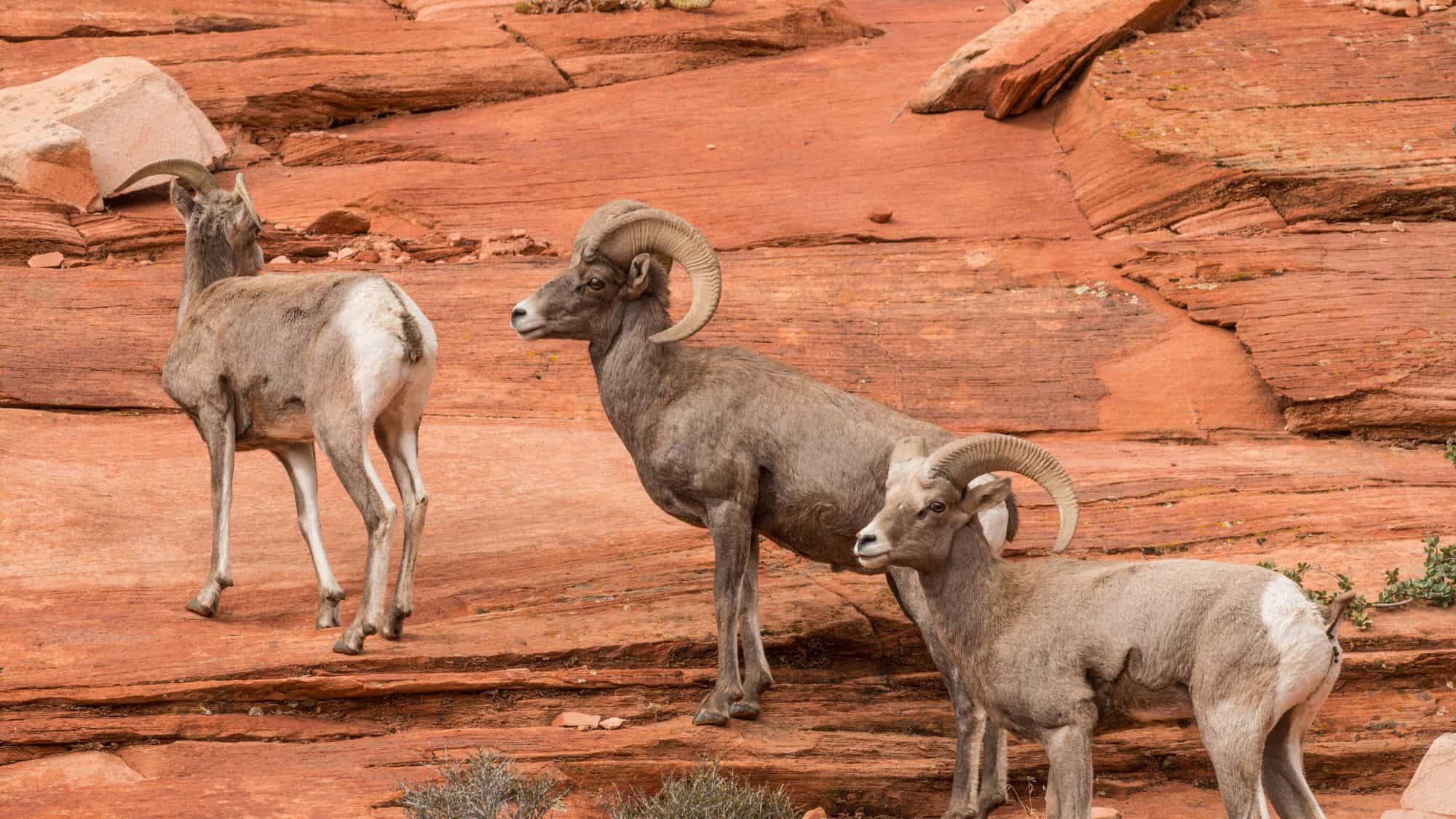
Desert bighorn sheep are masters of the vertical world. In Zion National Park, they inhabit the steep slickrock slopes and sandstone cliffs.
These sheep are smaller and leaner than their Rocky Mountain cousins. And their lighter build helps them navigate the heat and arid conditions of the desert southwest. Rams battle for dominance during the rut by clashing horns with a sound that echoes off the canyon walls.
They can go for days without drinking water by obtaining moisture from the plants they eat. When they do drink, they can consume gallons at a time at scattered potholes.
The population in Zion has rebounded significantly in recent years. Reintroduction efforts in the 1970s brought a small number of sheep back to the park. Today, the herd has grown to over five hundred individuals.
You have the best chance of seeing them on the east side of the park along the Zion-Mount Carmel Highway. Just keep in mind that their tan coats act as perfect camouflage against the Navajo sandstone. Often, you will look at a cliff face for minutes before realizing a herd is standing right in front of you.
While they have higher numbers than others on this list, their ability to traverse inaccessible terrain keeps them distant and aloof.
River Otter – Yellowstone National Park, Wyoming

Yellowstone is renowned for bears and wolves, but the river otter is the park’s most charming aquatic predator.
These members of the weasel family are active year-round. They do not hibernate even when winter temperatures drop well below zero.
In fact, they are highly mobile on snow and ice. They move by alternating between running and sliding on their bellies. This efficient mode of travel allows them to cover miles between water bodies.
River otters in Yellowstone feed primarily on cutthroat trout and invasive lake trout. They are also known to eat crayfish and frogs. And they are crepuscular, meaning they are most active at dawn and dusk.
Their sleek, dark bodies can be hard to distinguish from a swimming beaver or muskrat. However, their behavior sets them apart. Otters are agile swimmers that dive and roll with energy. They often hunt in family groups.
You are most likely to see them along the Yellowstone River or the shores of Yellowstone Lake.
Spotted Skunk – Shenandoah National Park, Virginia

Most people are familiar with the striped skunk that lumbers through suburban backyards. The eastern spotted skunk found in Shenandoah National Park is a smaller and more agile relative.
These weasels have a complex pattern of white swirls and spots on their black fur. They are strictly nocturnal and much more secretive than their striped cousins.
Spotted skunks are also excellent climbers. They will scamper up trees to escape predators or find food. This arboreal talent is unusual among skunks.
But the most famous trait of the spotted skunk is its defensive display. Before spraying, it will perform a handstand on its front legs. It flares its tail and shuffles toward the threat in this acrobatic pose. This serves as a final warning.
While striped skunks are common, spotted skunk populations have declined across much of their range. So sightings in Shenandoah are infrequent. And because they emerge only in total darkness and move quickly, they often go undetected, even by dedicated naturalists.
Pacific Fisher – Olympic National Park, Washington

The Pacific fisher is a forest-dwelling carnivore that resembles a large marten. They have dark brown fur, a long bushy tail, and a face that looks like a small bear.
Fishers were eliminated from Washington State by the mid-1900s due to over-trapping and habitat loss. But Olympic National Park became the site of a major reintroduction effort starting in 2008. Biologists released ninety animals from British Columbia into the park’s old-growth forests.
Fishers are one of the few predators capable of hunting porcupines. They attack the face of the porcupine to avoid the quills.
Spotting a fisher is exceptionally difficult. They stay deep within the forest canopy and travel along the ground in dense underbrush. They avoid open areas and clear-cuts.
Monitoring studies have shown that the reintroduced population is reproducing and spreading. However, their solitary nature and preference for remote wilderness mean they are almost never seen by casual hikers.
Collared Peccary – Saguaro National Park, Arizona
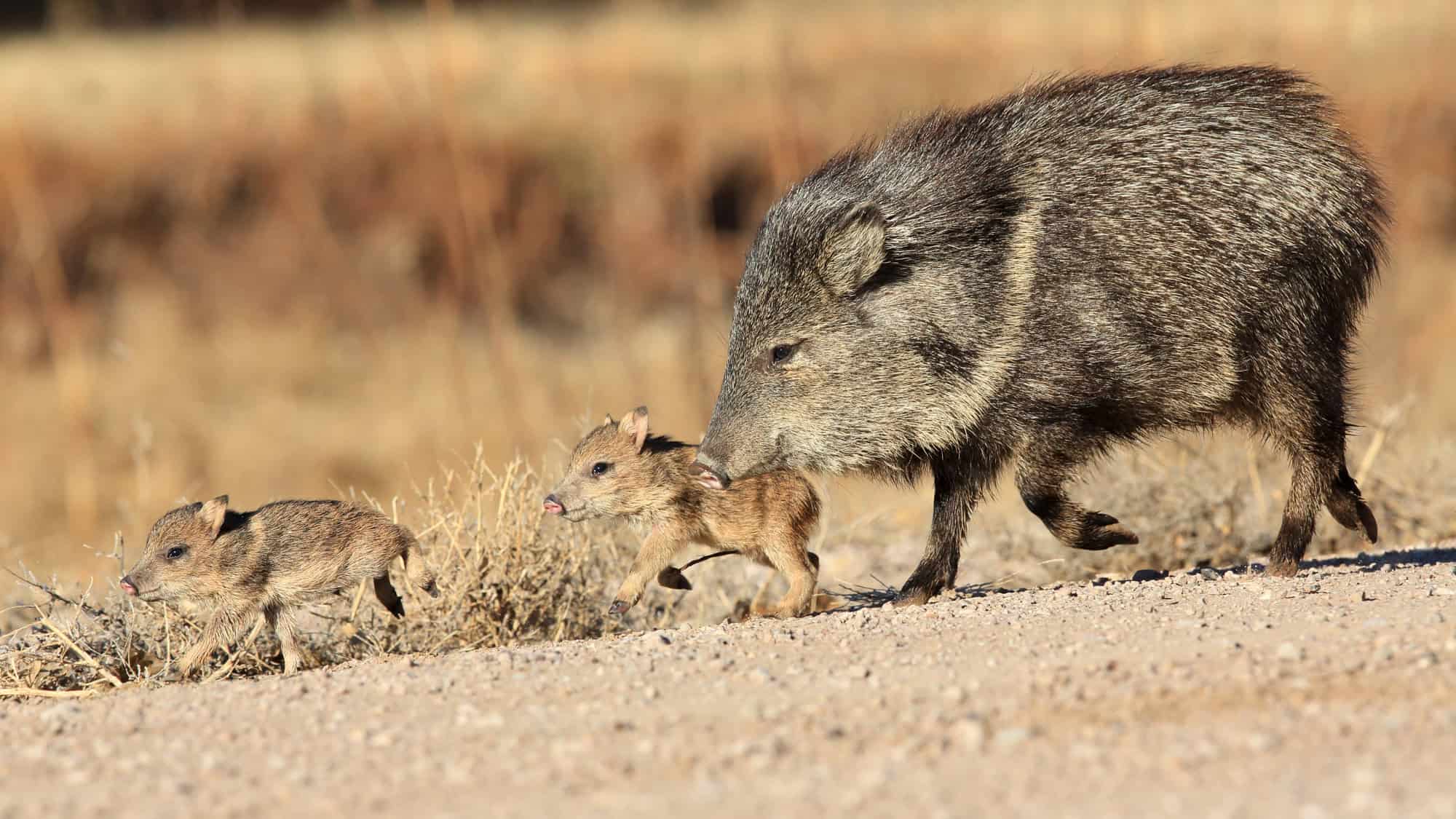
The collared peccary is the desert’s answer to the wild pig, though they belong to a different family entirely. Locally known as javelina, these animals are a staple of the Sonoran Desert ecosystem in Saguaro National Park.
Javelinas live in herds that can number a dozen or more. They rely on dense groups for warmth in winter and protection from predators like mountain lions and coyotes. They are named for the faint band of white hair that circles their neck.
You will often smell a javelina before you see one. They possess a scent gland on their back that releases a strong musk. They rub this scent on rocks and each other to maintain herd cohesion.
Javelinas feed on prickly pear cactus, mesquite beans, and roots. They are tough animals that can eat spiny cactus pads without injury.
While they are active in the cooler mornings and evenings, they spend the heat of the day resting in the shade of washes or rocky overhangs. And they blend in remarkably well with the desert scrub. In fact, visitors sometimes mistake them for boulders until the entire herd suddenly stands up and trots away.
While they are fairly elusive in Saguaro, you likely will have better luck spotting them in Big Bend National Park. We saw them nearly every morning in the green pastures down by the RV park within the park boundaries.
Like Our Content? Make sure to join our newsletter for all the latest on outdoor adventures (and a FREE STARGAZING GUIDE). Click here to sign up!