Discover Parks & Wildlife contains affiliate links and is a member of the Amazon Services LLC Associates Program. If you make a purchase using one of the Amazon links, we may receive compensation at no extra cost to you. We may also use select AI tools to support our creative process, but all content is reviewed, refined, and finalized by our human team. See our disclosure policy and our AI use policy for more information.
The Easter Egg Roll That Blends History, Pageantry, And Pure Childhood Joy
Spring arrives with blooms, birdsong, and the unmistakable sound of wooden spoons tapping pastel-painted eggs across freshly mowed grass.
Families gather under blue skies, children clutching handcrafted treasures, parents balancing cameras and coffee cups. The air hums with anticipation as eggs wobble down gentle slopes, some veering wildly off course, others rolling straight and true toward an invisible finish line. Laughter erupts. Cheers ring out. A tradition older than most grandparents repeats itself once more.
This is no ordinary backyard game. What began centuries ago as a simple European custom has transformed into one of America’s most beloved springtime celebrations.
From the South Lawn of the White House to historic presidential estates and community parks across the nation, the Easter Egg Roll draws families together in a shared moment of joy that transcends generations. It blends religious symbolism with playful competition, presidential history with accessible fun, and creates memories that children carry into adulthood.
How A European Tradition Crossed The Atlantic
The practice of rolling eggs during Easter stretches back to 19th-century Europe, though its roots may reach even further. In England, Scotland, and Germany, families gathered on hillsides after Easter services to roll hard-boiled eggs down grassy slopes.
The custom carried religious significance: eggs represented new life and resurrection, while the rolling motion symbolized the stone being rolled away from Christ’s tomb on Easter morning.
These gatherings were modest affairs, often organized by local communities rather than governments. Children decorated eggs with natural dyes made from onion skins, beet juice, and flower petals, then competed to see whose egg could roll the farthest without cracking.
Winners earned bragging rights, and everyone enjoyed a picnic lunch featuring the eggs that survived the competition.

When European immigrants arrived in America, they brought this tradition with them. By the 1870s, families in Washington, D.C., had established their own egg-rolling gatherings on the west grounds of the U.S. Capitol.
The event grew quickly, attracting hundreds of children and their families each Easter Monday. The Capitol’s sloping lawns provided perfect terrain for racing eggs, and the location added a sense of civic pride to the celebration.
However, Congress grew concerned about the damage being done to the carefully maintained grounds. In 1876, President Ulysses S. Grant signed legislation banning egg rolling on Capitol property, citing landscape preservation as the official reason.
The law took effect the following year, leaving families without their beloved Easter tradition and children wondering where they would roll their eggs in 1878.
President Hayes Opens The White House Gates
On Easter Monday 1878, a group of children approached the White House gates with decorated eggs in hand and hope in their hearts.
President Rutherford B. Hayes, having heard about the Capitol Hill ban, made a decision that would create a lasting American tradition. He instructed his staff to open the South Lawn to the public, welcoming families to roll their eggs on White House grounds instead.
The first official White House Easter Egg Roll drew modest crowds, but word spread quickly. By 1889, President Benjamin Harrison had added the United States Marine Band to the festivities, filling the air with lively marches composed by John Philip Sousa.
The tradition continued to grow, with each presidential family adding their own touches to the event.
During the early 20th century, attendance swelled dramatically. The 1921 Easter Egg Roll, the first held after a five-year wartime suspension, attracted between 50,000 and 60,000 children and their families. President Warren G. Harding, First Lady Florence Harding, and their dog Laddie Boy greeted attendees, while actors dressed as characters from “Alice and the White Rabbit” entertained the crowds.

When First Ladies Left Their Mark
While presidents officially hosted the Easter Egg Roll, First Ladies became the tradition’s architects, infusing the event with their personal style and interests.
Lou Hoover, wife of President Herbert Hoover, introduced folk dancing to the 1929 celebration, roping off a section of the South Lawn for Girl Scouts to perform maypole dances. She also arranged for the event to be broadcast on the radio for the first time, allowing families across the nation to hear the festivities.
Pat Nixon, First Lady during the Nixon administration, created the Easter Egg Roll races that remain central to the event today. Her addition transformed the activity from casual egg rolling into organized competitions with clear winners and prizes.
The 1974 event featured volunteers dressed as clowns who organized the races and distributed Nixon-branded ballpoint pens to victorious children.
Nancy Reagan introduced the commemorative wooden egg in 1981, establishing what would become one of the event’s most cherished traditions. Each egg bore the signatures of President Ronald Reagan and the First Lady, transforming a simple keepsake into a collectible treasure.
Previous administrations had distributed hard-boiled eggs, but the wooden versions proved more durable and meaningful for families who wanted to preserve their White House memories.
Barbara Bush brought family warmth to the 1989 Easter Egg Roll, appearing with several of her children and grandchildren alongside the family dog, Millie. The White House kitchen staff prepared 5,000 hard-boiled eggs for that year’s event, while volunteers hid 23,000 wooden eggs across the South Lawn for children to discover.

The Modern Spectacle Takes Shape
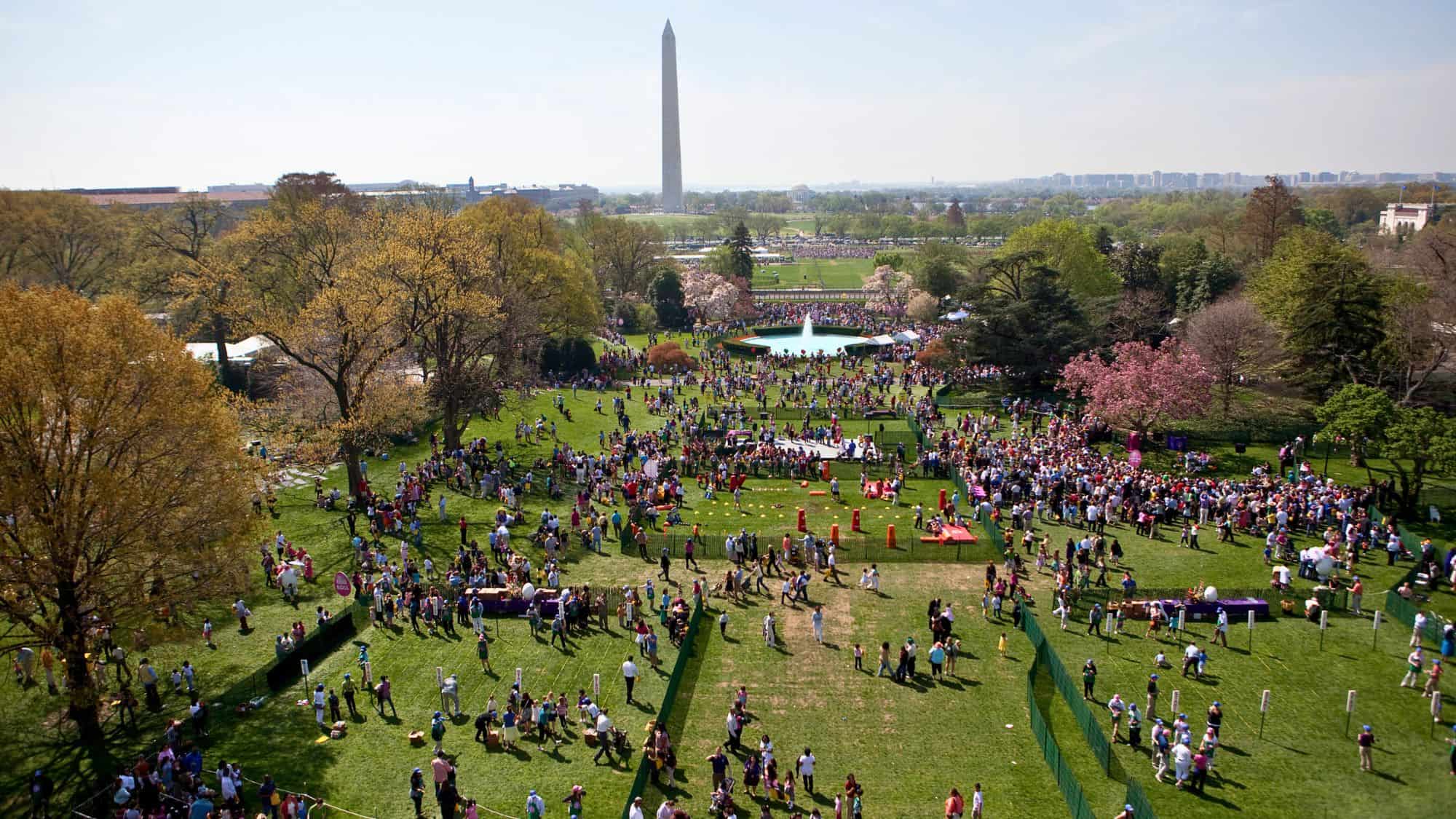
Today’s White House Easter Egg Roll bears little resemblance to its humble 1878 origins. The event now features celebrity appearances, live musical performances, storytelling sessions with children’s authors, and interactive activity stations scattered across the South Lawn.
The Marine Band continues its tradition dating back to 1889, while modern additions include cooking demonstrations promoting healthy eating and sports activities featuring professional athletes.
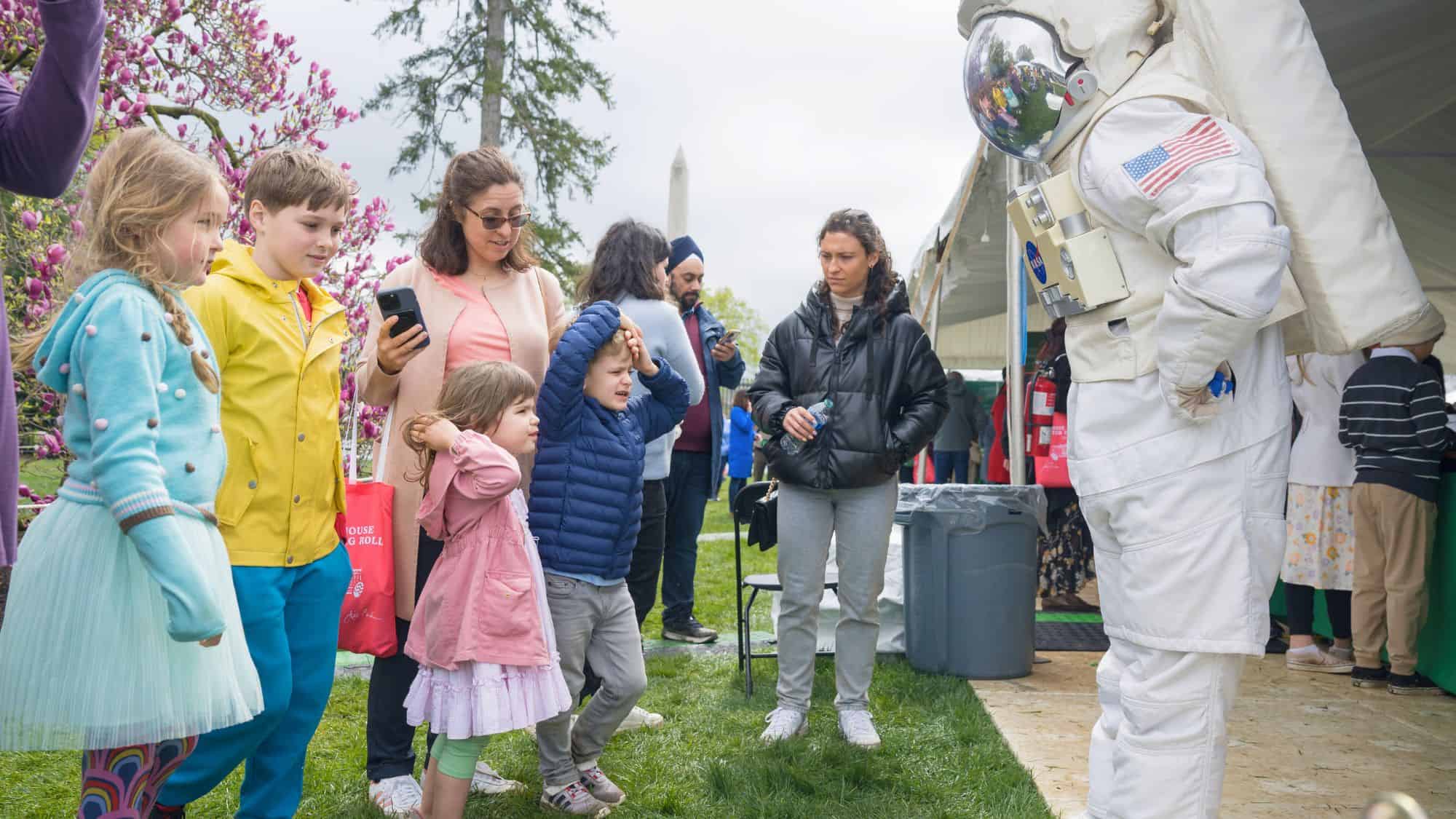
The official Easter Bunny made its first appearance in 1969 when a staff member donned a white jumpsuit and rabbit mask to greet children along the South Lawn’s circular driveway. The costumed character has remained a fixture ever since, posing for thousands of photographs each year and serving as the event’s unofficial mascot.
Attendance is strictly controlled through an online lottery system that opens several weeks before Easter. Families with children aged 13 and under can enter for free tickets, with each household limited to one application for up to six tickets.
Millions of families apply annually, making the lottery one of the most competitive in the country. Winners receive email notifications and must specify their preferred time slot, as the event operates in shifts throughout Easter Monday to accommodate the crowds.
Planning Your White House Easter Egg Roll Experience
Here’s what you need to know to prepare for the White House and make the most of this cherished spring celebration.

Advance Tickets
Attending the White House Easter Egg Roll means securing your place through a competitive online lottery, which typically opens several weeks before Easter.
For 2026, the lottery opened on February 26 and closed on March 4, with results released on March 10. Winners received confirmations by email and then selected their preferred entry time, since attendance is staggered across sessions for crowd control on Easter Monday.
Occasionally, a small number of last-minute tickets appear on recreation.gov as families adjust plans or release spots they can no longer use, so checking closer to the event can pay off if you didn’t win your spot initially.
But for the best chance in future years, keep an eye on official White House announcements and submit your lottery entry as soon as the window opens.
What To Bring And What’s Allowed
There are strict rules about what you can bring to the South Lawn due to White House security protocols. Bags must be small and easy to search; backpacks and large purses are not allowed. Strollers for young children are permitted, but expect your belongings to be screened at a security checkpoint.
Comfortable walking shoes, sun hats, and non-glass water bottles help ensure you and your children stay comfortable throughout the day. Cameras and phones are allowed, letting you capture special moments.
Always review the official guidelines released for each year’s event before arrival to avoid surprises at the entry gate.
Preparing For The Weather
Washington, D.C., in early spring can offer everything from crisp sunlight to sudden spring showers, so weather-appropriate preparation is key.
Dress in lightweight, layered clothing to adapt to changing temperatures. Since the event is held rain or shine and there’s little overhead cover on the South Lawn, umbrellas and ponchos safeguard against unexpected rain.
Sunscreen and hats are smart for sunny conditions, but leave pop-up tents and large shade structures behind; these are not permitted.
If inclement weather requires changes to the schedule, updates are communicated directly to ticket holders via the email they used for registration.
Keepsakes And Collectibles
One of the most beloved aspects of the White House Easter Egg Roll is the unique wooden egg distributed to children attending the event. Each year’s egg features new designs and the signatures of the president and First Lady, turning it into a sought-after keepsake.
These eggs serve as mementos that connect families to the legacy of this historic celebration. Many families display their eggs at home, creating a colorful timeline of their Easter memories on the South Lawn.
Additionally, limited merchandise, such as egg-themed totes and apparel, may be available for purchase at the event or through the White House Historical Association.
Coast To Coast Celebrations Offer Alternatives
Families unable to secure White House tickets or preferring to celebrate closer to home have numerous options across the country. Major cities and historic sites host their own Easter Egg Roll events, each adding local flavor while honoring the tradition’s spirit.
New York City’s Easter Parade and Easter Bonnet Festival takes over Fifth Avenue from 49th to 57th Streets each Easter Sunday. The celebration runs from 10 a.m. to 4 p.m., drawing thousands of participants who don elaborate bonnets and spring finery.
While not an egg rolling event, the parade captures the same festive energy and has been a New York tradition since the 1870s, making it contemporary with the White House celebration.
Lincoln Park Zoo in Chicago hosts Spring Egg-Stravaganza each year, typically scheduled for the Saturday before Easter. Children ages 1 through 8 can participate in organized egg hunts, meet zoo experts, ride the Endangered Species Carousel, and pose for photos with the Easter Bunny.
Underwood Family Farms near Los Angeles transforms into an Easter wonderland each spring with its Springtime Easter Festival. The multi-week celebration features egg hunts, egg tosses, egg decorating stations, a giant Easter basket photo opportunity, and appearances by the Easter Bunny.
The farm’s rolling hills and scenic setting provide a California twist on the traditional egg roll, with events typically running from late March through mid-April.
Why This Tradition Endures
The Easter Egg Roll survives because it offers something increasingly rare: a shared national experience that welcomes everyone.
Unlike exclusive galas or ticketed spectacles, this tradition maintains its democratic spirit. Whether rolling eggs on the White House lawn or at a community park, families participate in the same fundamental activity that has connected generations since 1878.
The tradition also adapts while preserving its core elements. Modern additions like celebrity appearances and interactive stations keep the event fresh for new generations, while the egg rolling races themselves remain unchanged.
This balance between innovation and tradition allows the Easter Egg Roll to feel both timeless and current.
For children, the event creates memories that outlast the decorated eggs they bring home. The excitement of competing in races, the pride of meeting the Easter Bunny, and the simple joy of spending a spring day outdoors with family become stories they later share with their own children.
The Easter Egg Roll also demonstrates how simple pleasures need not be complicated or expensive to bring happiness. A hard-boiled egg, a wooden spoon, and a grassy slope provide all the equipment necessary for an afternoon of entertainment.
In an era of elaborate theme parks and screen-based entertainment, the egg roll proves that sometimes the old ways work best.
Like Our Content? Follow Us on MSN (or click the Follow Button above) for more from Discover Parks & Wildlife.