Discover Parks & Wildlife contains affiliate links and is a member of the Amazon Services LLC Associates Program. If you make a purchase using one of the Amazon links, we may receive compensation at no extra cost to you. We may also use select AI tools to support our creative process, but all content is reviewed, refined, and finalized by our human team. See our disclosure policy and our AI use policy for more information.
These 14 Rare Animals Are Why The Galápagos Islands Tops Every Wildlife Bucket List
When you finally set foot on this volcanic archipelago located roughly 600 miles off the coast of Ecuador, the first thing you notice is the audacity of the locals. Unlike animals in the rest of the world, who have the good sense to run away when a human approaches, the wildlife here acts like they own the place (which, to be fair, they do).
Because these islands rose directly from the sea and were never connected to the mainland, every creature had to arrive by swimming, flying, or floating on debris rafts across the open ocean. It is the ultimate survivalist reality show. And once they washed ashore, they looked around at the harsh, rocky landscape and decided to get weird with their evolution.
The result is a biological laboratory that feels completely detached from reality. You are not just observing nature here; you are stepping into a prehistoric bubble where fear simply was not included in the software update.
Get ready to meet the strangest residents of the Pacific, who have absolutely zero interest in your personal space.
Galapagos Tortoise

These massive reptiles are the undisputed heavyweights of the islands, and seeing one in person feels a bit like meeting a celebrity who is famous for doing absolutely nothing.
The Galapagos tortoise is the largest living tortoise species on the planet, with some males tipping the scales at over 500 pounds. They are the reason the archipelago has its name, derived from the old Spanish word for a riding saddle, though we strongly advise against trying to ride one (they are not fast, and it is frowned upon).
Their lifespan is just as impressive as their girth, with many individuals living well past 100 years. Basically, they have seen history unfold and remained completely unimpressed by all of it. Instead, they spend their days as slow-motion grazing machines, mowing down grass, leaves, and cactus pads before taking a 16-hour nap.
The most fascinating aspect of these gentle giants is how they differ depending on their zip code. On lush islands with ground-level vegetation, tortoises have dome-shaped shells because they do not need to reach very high for dinner.
But on arid islands where food is scarcer and higher up, they evolved “saddleback” shells that allow their long necks to extend vertically to reach tall cactus pads. It is this variation that helped Charles Darwin figure out natural selection.
Marine Iguana

If you stumble upon a colony of marine iguanas sunning themselves on the black lava rocks, you might think you have accidentally walked onto the set of a low-budget monster movie. These are the only lizards in the world that forage in the ocean, a lifestyle choice that seems exhausting for a cold-blooded reptile.
They are not winning any beauty pageants (Darwin himself called them “imps of darkness”), but their adaptations are brilliant. They can dive up to 30 feet deep to scrape green algae off underwater rocks, using their sharp claws to anchor themselves against the strong currents.
Because the water is cold, they can only stay down for a short time before they have to haul themselves back onto land to bake in the sun and raise their body temperature again.
You will constantly see them sneezing, which looks incredibly rude but is actually a vital survival mechanism. Because they swallow a lot of seawater while grazing, they have specialized glands that filter salt from their blood, which they then forcibly sneeze out of their nostrils. This often leaves them with a crusty white “wig” of salt on their heads, giving them the look of a disgruntled George Washington.
While they are usually black or grey to absorb heat, the males on Espanola Island turn vibrant shades of red and green during the mating season. It is their version of a flashy suit, earning them the nickname “Christmas Iguanas.”
Galapagos Racer Snake

While most people do not book a trip to the islands hoping to see snakes, the Galapagos racer is a fascinating predator that demands respect (mostly because it is fast, and you are clumsy on lava rocks).
In the absence of large land carnivores, these snakes have happily taken the role of top predator in their specific niche, hunting lava lizards, geckos, and insects. They are diurnal, meaning they hunt during the day, so there is a solid chance you will see one zipping through the dry brush or sunbathing on a rock.
The population on Fernandina Island gained internet fame thanks to a documentary that filmed dozens of them hunting hatchling marine iguanas in a pack. It looked like a nightmare scenario, but it highlighted a behavior unique to this location: they are the only terrestrial snakes in the world known to hunt for marine prey in rock pools.
On other islands, they are solitary hunters who rely on stealth and speed. Their brown pattern with lateral stripes offers excellent camouflage against the dried leaves and volcanic terrain.
Just so you know, these slender, mild-mannered constrictors are only slightly venomous (and harmless to humans), so you can stop clutching your pearls now.
Lava Lizard

It is statistically impossible to walk five feet in the Galapagos without seeing a lava lizard doing push-ups on a rock like it is trying to impress a gym crush. In fact, these small reptiles are the most abundant wildlife you will encounter.
There are seven distinct species scattered across the archipelago. And they are generally small, rarely exceeding a foot in length. But they have egos the size of the islands themselves. The males are larger with more intricate patterns, while the females often sport a bright red throat or head, which makes them look like they are perpetually blushing or perhaps suffering from a terrible sunburn.
Those push-ups are not just for fitness; they are a complex language. Males perform these jerky bobbing motions to mark their territory and warn off rivals, while also trying to catch the eye of a female. The specific pattern of the push-ups varies by species, acting as a secret code to ensure they do not accidentally flirt with the wrong type of lizard.
If a predator manages to grab one by the tail, the lizard can simply detach it and run away, growing a new one later. It is a neat party trick, even if the replacement tail never looks quite as good as the original.
They are also the unsung heroes of pest control, munching on flies, beetles, ants, and sometimes even smaller lizards if they are feeling particularly cannibalistic.
Flightless Cormorant

This bird is the ultimate example of evolution looking at a skill set and saying, “You know what? We don’t need that anymore.” The flightless cormorant is the only cormorant species in the world that has completely lost the ability to fly.
Found exclusively on the islands of Fernandina and Isabela, these birds evolved in an environment with no land predators, so the energy required to maintain big wings and flight muscles was just wasted effort. Instead, they have scraggly, vestigial wings that are about one-third the size of a functional flying bird’s wings.
They look a bit like they are wearing a tattered trench coat that shrank in the wash. It is an evolutionary aesthetic that screams “I gave up,” but it works for them.
What they lack in air travel, they make up for in the water. They are powerful swimmers with massive legs and webbed feet, diving to the ocean floor to hunt for octopus, eels, and fish.
Their feathers are not waterproof like a duck’s, which actually helps them sink and dive more efficiently, but it means they get thoroughly soaked. So you will often see them standing on the shore with their stubby wings spread out to dry in the sun, looking like they are waiting for a hug that is never coming.
Galapagos Sea Lion

If the islands had a mascot, it would undoubtedly be the Galapagos sea lion, mostly because they refuse to be ignored. They are everywhere: lounging on park benches in town, draping themselves over boat decks, and bodysurfing in the waves.
These sea lions are a distinct species from their Californian cousins, slightly smaller and arguably much more charismatic. They are incredibly social and vocal, with a bark that sounds remarkably like a dog, which can be startling when you are walking past a dark bush at night and it yells at you.
While they can be absolute loafers on land, looking like melting puddles of fur on the sand, they transform into acrobatic torpedoes the moment they hit the water.
You will often encounter “nurseries” where pups hang out together in shallow pools while the adults fish, usually supervised by a single female babysitter who looks exhausted.
The bulls are massive, weighing up to 550 pounds, and can be aggressively territorial, patrolling the shoreline and barking warnings at rivals. The males have a distinct bump on their forehead, which helps distinguish them from the sleek females.
Regardless of gender, they are incredibly curious and will often approach snorkelers to blow bubbles or mimic movements, but it is always smart to keep a respectful distance (especially from the grumpy bulls who take their job as beach monitor very seriously).
Galapagos Penguin

Seeing a penguin standing on a jagged black lava rock next to a prickly pear cactus is one of those sights that makes your brain do a double-take.
The Galapagos penguin is the only penguin species found north of the equator, and they manage to survive the tropical heat thanks to the Humboldt and Cromwell currents, which bring freezing cold, nutrient-rich water up from the deep ocean.
They are the second smallest penguin in the world, standing only about 19 inches tall, which just adds to their undeniable cuteness. And they look like they are dressed for a formal event but showed up at a beach party by mistake.
To cope with the equatorial sun, they have developed behaviors to keep cool, such as panting like dogs and hunching forward to shade their sensitive feet from the sun. They also nest in deep crevices in the lava rather than out in the open, which keeps their eggs from scrambling in the heat.
You will often see them diving into the water to cool off, where they are agile hunters, darting through schools of fish with incredible speed. Unfortunately, they are also endangered and very sensitive to El Nino events, which warm the water and kill off their food supply.
Galapagos Land Iguana

While their marine cousins are black and jagged, the land iguanas are massive, golden-yellow dragons that look like they belong in a prehistoric era. They can grow over three feet long and weigh up to 30 pounds, making them a substantial stumbling hazard.
They are primarily vegetarians, and their favorite meal is the prickly pear cactus. In fact, they have developed a tough mouth and digestive system that allows them to eat the cactus pads (spines and all) without flinching. Watching one crunch down on a mouthful of sharp needles is enough to make your own teeth hurt, but they seem to enjoy it like it is a crunchy potato chip.
They get much of their water moisture from the cactus pads, allowing them to survive long droughts. Some individuals even live up to 60 years (which is a really long time to spend eating thorns).
They are generally solitary creatures, spending their days basking in the sun to maintain their body temperature or resting in the shade of the very cactus they intend to eat later.
The males can be territorial, bobbing their heads aggressively at intruders to show who is boss. Darwin was not particularly kind to them either, calling them “ugly animals” with a “singularly stupid appearance,” which seems unfair given how well-adapted they are.
Waved Albatross

This bird is an absolute giant, boasting a wingspan of up to eight feet, making it the largest bird in the archipelago. And the waved albatross breeds almost exclusively on Espanola Island, meaning the entire world’s population is essentially concentrated in one spot for a massive family reunion.
They are masters of the air, capable of gliding for hours without flapping their wings, utilizing the wind currents off the ocean. However, watching them take off and land is a comedy show; they require a runway and often tumble or trip over their own large feet because they are so ungainly on solid ground.
Their courtship ritual is legendary and one of the most complex displays in the animal kingdom. Mated pairs (they mate for life) engage in a rapid-fire dance that involves bill circling, loud clacking sounds, bowing, and a distinct “moo” sound. It looks like a choreographed sword fight performed by birds who have had too much caffeine.
They arrive on Espanola in late March to nest and leave by December, spending the rest of the year entirely at sea off the coast of Peru and Ecuador. Seeing thousands of these massive birds nesting on the cliffs is a spectacle of noise and motion you will not forget.
Galapagos Fur Seal

Despite the name, this animal is technically a sea lion (it has external ear flaps), but it is much fluffier and shyer than its loud cousin. Think of it as the introverted artist of the seal family who prefers dark corners to the spotlight.
The Galapagos fur seal is the smallest of the eared seal species and has giant, bulging eyes that help it hunt at night. They prefer rocky, shaded coastlines and sea caves rather than open sandy beaches, mainly to avoid the intense equatorial heat. Their coat is incredibly thick, which was nearly their downfall in the 19th century when hunters decimated their population for fur.
Because they are nocturnal hunters, they spend most of their days sleeping deeply in hidden crevices or under overhangs. They feed mostly on squid and fish that come near the surface after dark.
They are agile climbers, capable of scaling steep, rocky cliffs that a regular sea lion would not even attempt, often looking like mountain goats in wetsuits. And they are generally much more reclusive, so spotting one usually requires a keen eye scanning the shadowed lava grottos.
They look a bit like oversized teddy bears, but do not be fooled; they can be quite feisty if you corner them.
Galapagos Hawk

As an apex predator of the islands, the Galapagos hawk walks around with an attitude that matches its status.
They are dark brown, broad-winged, and hunt everything from lava lizards and snakes to baby tortoises and sea turtle hatchlings. And they play a critical role in keeping the ecosystem balanced, essentially serving as the island’s cleanup crew.
Their social structure is fascinatingly rare; they practice cooperative polyandry. This means a single female will mate with several males, and all the males help raise the chicks, defending the nest and bringing food. This cooperation helps the chicks survive in the harsh, unpredictable environment where food can be scarce.
These raptors have virtually no fear of humans because they have never been hunted, so they treat tourists less like threats and more like interesting furniture. It is not uncommon for a young hawk to swoop down and land on a guide’s walking stick or even a camera lens to get a better view.
You will often see them soaring high on thermal currents scouting for movement below. They are the only resident hawk species in the islands, so if you see a raptor, you can be sure you are looking at the king of the Galapagos sky.
Swallow-Tailed Gull
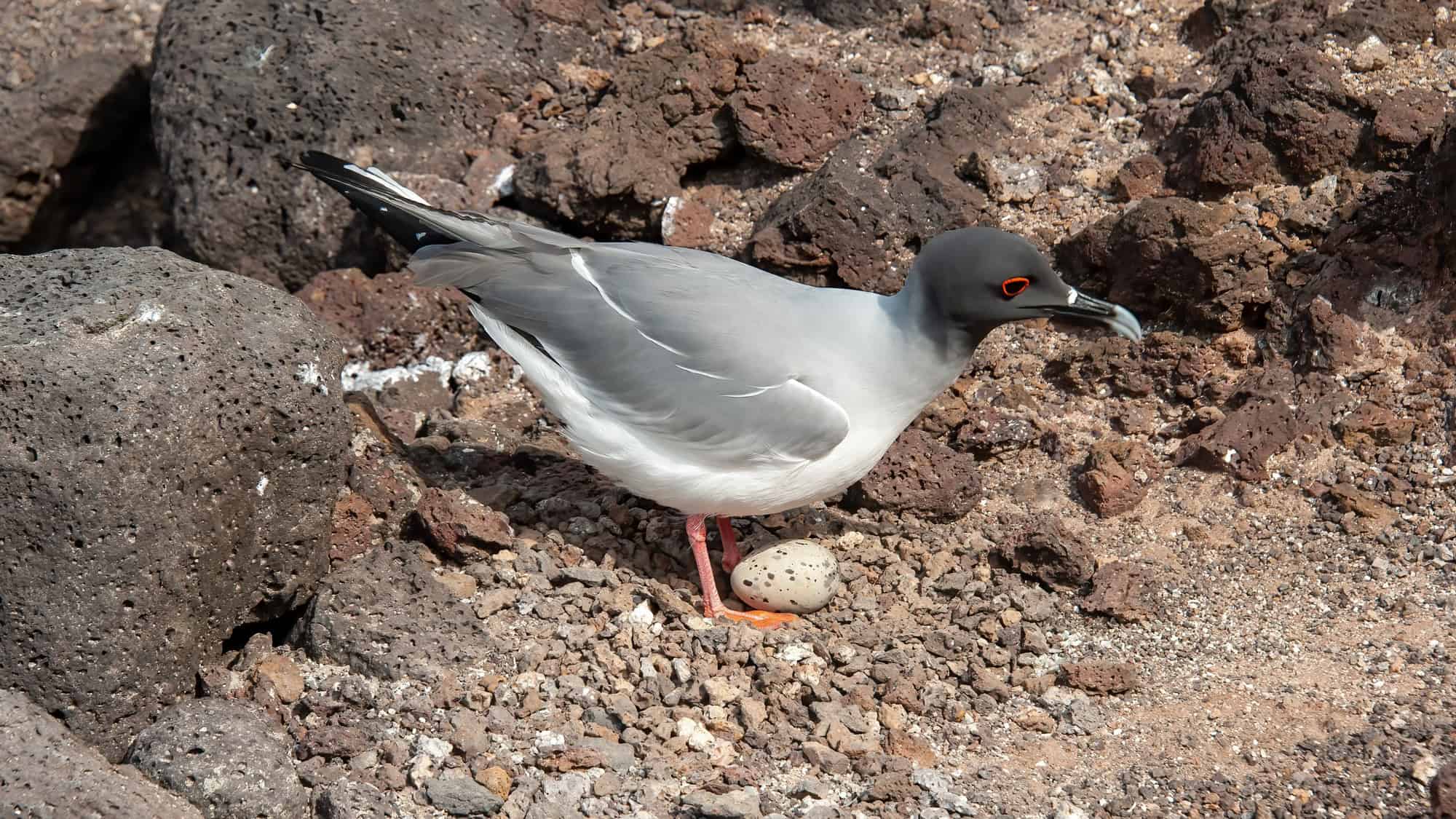
Meet the only seagull in the world that prefers a night out to an early morning. The swallow-tailed gull is exclusive to the Galapagos and also wears the crown of the world’s only fully nocturnal gull.
If you’re a light sleeper, don’t worry too much: these birds do all their fishing under the cover of darkness and only keep the squid and small fish up at night (your vacation snacks are safe). During the day, the gulls tend to laze about on cliffs or rocky shores looking ruffled and ever-so-slightly disapproving, as if they’re judging everyone for waking up so early.
Two things make them instantly memorable: their dramatic red eye ring and the extravagant V-shaped tail that gives them their name.
That pop of color isn’t just for show; their giant, moon-bright eyes help them see in the pitch-black Galapagos nights. And they have more melanin in their eyes than any other gull, which acts like built-in sunglasses for when they come out into the blazing sun.
Of all the quirky characters on the islands, these nocturnal party animals are truly one-of-a-kind, thriving where their competition keeps hitting snooze.
Darwin’s Finches

They might look like simple, drab little birds that you would ignore in your own backyard, but these finches are scientific royalty. There are about 17 species found here, and while they look similar, the secret is in the beak.
Each species evolved a specialized beak shape to exploit a specific food source: crushing seeds, catching insects, or sipping nectar. It was observing these variations that helped Charles Darwin solidify his theory of evolution by natural selection.
Ironically, they are not actually true finches but are more closely related to tanagers, proving that even in nature, labels can be misleading. And the behavior of some of these finches is straight out of a horror movie or a sci-fi novel.
The woodpecker finch, for instance, uses a cactus spine or twig as a tool to dig grubs out of tree bark, making it one of the few tool-using birds in the world.
Then there is the vampire finch, found on Wolf and Darwin islands, which pecks at the tail feathers of seabirds until they bleed and then drinks the blood to survive the dry season. It is a gruesome but brilliant adaptation to a water-scarce environment that proves survival of the fittest can get messy.
Santa Fe Land Iguana

This is a deep cut for the true nature enthusiast who thinks regular iguanas are just too mainstream. While the regular land iguana is found on several islands, the Santa Fe land iguana is restricted entirely to the small, cactus-covered island of Santa Fe.
They are distinct from the other land iguanas, generally paler in color with a more yellowish or pinkish hue and smaller dorsal spines. They evolved separately on this island, which is geologically one of the oldest in the archipelago (around 4 million years old).
Because there are no goats or introduced predators on Santa Fe, these iguanas have thrived and are incredibly abundant. You will see them sitting under the massive Opuntia cacti, which grow like giant trees here, waiting for lunch to fall from the sky. It is the reptile equivalent of waiting for a pizza delivery that never needs a tip.
The sheer concentration of them on this one small island makes walking around feel like you have entered a reptile sanctuary where the inmates run the asylum. And it is a perfect example of how a single island can create an entirely new species just by being isolated enough for long enough.
Bonus: Galapagos Shark

This one is a bonus because while it was discovered at the Galapagos, it is not truly endemic to just the islands like the other species on this list.
This shark species can be found near other oceanic islands worldwide. But as I mentioned, it was first discovered and described here, and the sheer density of them in these waters is unique. In many other parts of the world, seeing large sharks is rare due to overfishing, but in the protected Galapagos Marine Reserve, they thrive like they are at an all-you-can-eat buffet.
They are large requiem sharks, growing up to 10 or 12 feet, and they have a reputation for being curious and bold. They often patrol in large numbers around islands like Wolf and Darwin, creating a wall of sharks that is both terrifying and majestic.
They look like the quintessential shark (sleek, gray, and powerful), basically exactly what you picture when the Jaws theme starts playing in your head. And they feed on bottom-dwelling fish, squid, and octopus, but are not shy about investigating sea lions (or divers).
Seeing a school of dozens of them silhouetted against the sun-dappled surface is a bucket-list moment for divers, provided you stay calm.
Like Our Content? Make sure to join our newsletter for all the latest on outdoor adventures (and a FREE STARGAZING GUIDE). Click here to sign up!