Discover Parks & Wildlife contains affiliate links and is a member of the Amazon Services LLC Associates Program. If you make a purchase using one of the Amazon links, we may receive compensation at no extra cost to you. We may also use select AI tools to support our creative process, but all content is reviewed, refined, and finalized by our human team. See our disclosure policy and our AI use policy for more information.
You Might Not Expect This Desert National Park To Feel Magical, But These 11 Reasons Prove Otherwise
There is a specific kind of silence that you only find in the Sonoran Desert. It is not an empty silence but a heavy, expectant one, like the moment right before a stand-up comedian delivers a punchline you are not sure you will get.
Standing in the middle of Saguaro National Park, surrounded by thousands of prickly giants that look suspiciously like they might start waving the moment you turn your back, you realize this is not just a dry patch of dirt. It is a cathedral of resilience where everything is trying very hard not to get eaten.
It is a place where time moves differently, measured not in minutes but in the slow, deliberate growth of succulents that have been standing guard since before electricity was invented. You come here expecting desolation (a lot of beige and maybe a tumbleweed or two), but instead, you find a landscape that is shouting with life.
It challenges your perception of what “wilderness” means, proving that beauty does not always need lush forests or crashing waves. Sometimes, it just needs a few thousand tons of cactus and a sunset that looks like it was painted by Bob Ross.
Ready to discover what makes this wild desert so unforgettable? Let’s dig into the reasons Saguaro National Park steals the spotlight every single time.
Giant Saguaro Cactus

The undisputed kings of this landscape are the Saguaro cacti. These aren’t just plants; they feel like silent observers judging your hiking outfit.
It is genuinely unnerving how much personality a vegetable can have when it towers over you at 40 to 60 feet tall. You might even catch yourself nodding a greeting to them as you pass by (don’t worry, we all do it).
These giants are the defining feature of the Sonoran Desert, found exclusively in this pocket of the United States and northern Mexico. They are the skyscrapers of the American West, built slowly and deliberately over centuries.
A single saguaro can live to be between 150 and 200 years old, meaning many of the cacti you stand next to were already growing when the Titanic set sail. They are master survivalists.
During a heavy rainstorm, a fully grown saguaro can absorb and store enough water to weigh over 4,000 pounds. That is roughly the weight of a mid-size SUV balanced on a relatively small root system.
And they don’t even start growing their iconic arms until they are around 50 to 70 years old, so if you see one with a dozen arms flailing about, you are looking at the granddaddy of the forest. It commands respect, mostly because if it fell on you, it would be game over.
Stargazing
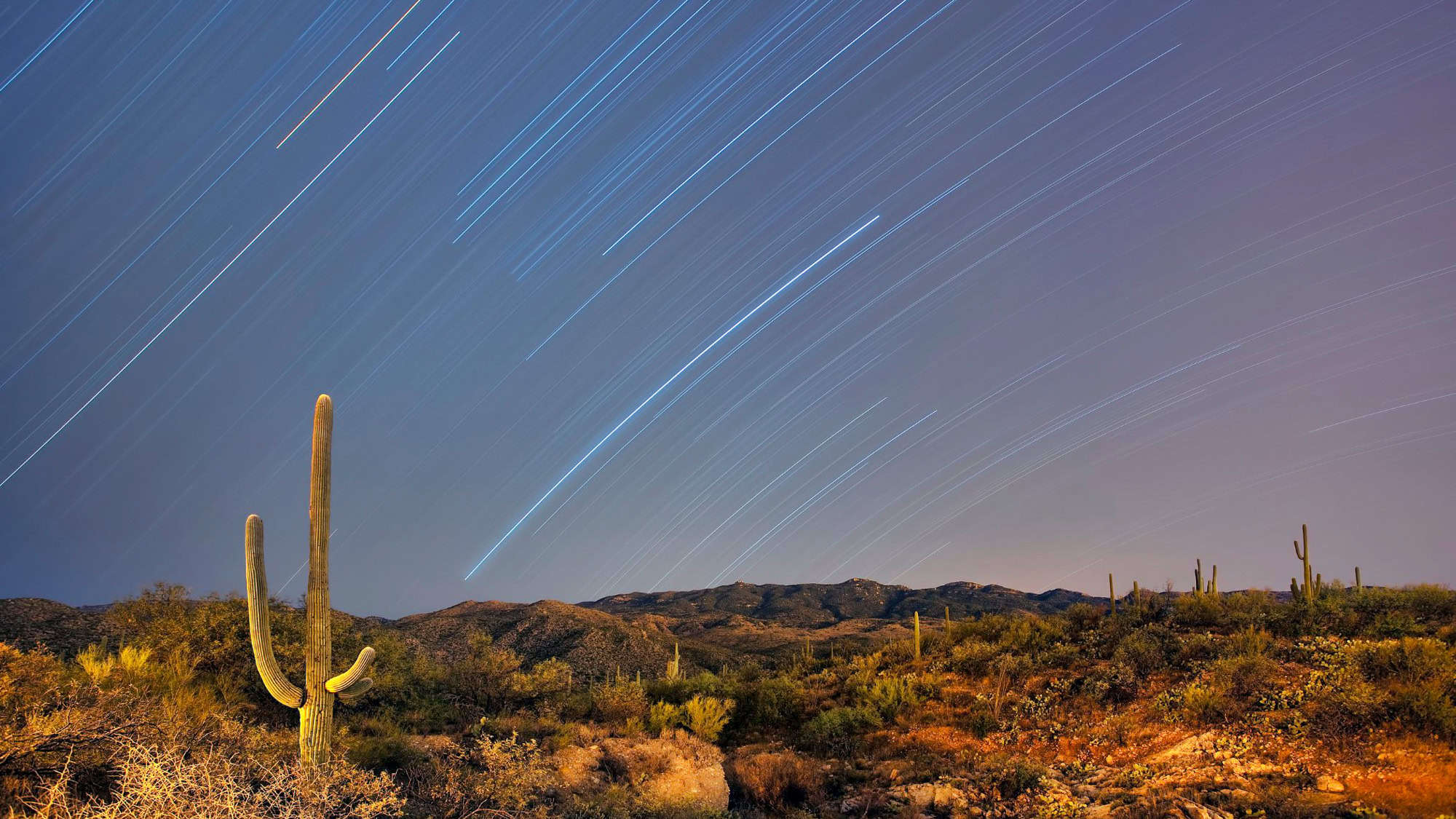
City dwellers often forget what the sky actually looks like. We get used to a muddy shade of purple-grey that passes for night, but out here, the darkness is absolute.
Saguaro National Park was designated as a Certified International Dark Sky Park in 2011, acknowledging its exceptional quality of starry nights. It is one of the few places left where you can look up and feel entirely insignificant in the best possible way.
The sheer volume of stars visible to the naked eye here is enough to make you dizzy if you stare too long (so maybe bring a chair).
Tucson has strictly enforced outdoor lighting ordinances to protect the night sky for the nearby observatories, which benefits park visitors immensely. You can see the Milky Way stretch across the horizon like a spilled bucket of diamond paint.
On a clear night, which is most nights in Arizona, you can spot planets without a telescope. It is the perfect activity for those of us who enjoy nature but prefer to do it while sitting perfectly still with a beverage in hand.
The desert cools down rapidly once the sun clocks out, so bring a sweater unless you want to shiver your way through the constellations.
Hugh Norris Trail To Wasson Peak

If you are the type of person who thinks a vacation isn’t real unless your quads are burning, the Hugh Norris Trail is calling your name. This is the longest trail in the Tucson Mountain District, and it is not for the faint of heart (or the empty of water bottle).
The trail sends you climbing up a ridgeline that offers relentless views on both sides, eventually depositing you at Wasson Peak. At 4,687 feet, this is the highest point in the Tucson Mountains, giving you a vantage point that makes the sprawling city below look like a toy set.
The hike is roughly 7-10 miles round trip (depending on which route you choose) with an elevation gain of about 2,100 feet. It’s a slog, but the payout is incredible.
You get to walk through diverse vegetation zones, watching the plant life change as you ascend. One minute you are dodging prickly pears, and the next you are standing in a slightly cooler breeze at the summit.
The path was originally built by the Civilian Conservation Corps in the 1930s, and you have to admire the stamina of the people who carved this route out of rock and hard earth.
Just remember to start early. The sun on this exposed ridge takes no prisoners, and turning into human jerky is not a great way to end the day.
Spring Wildflowers

People assume the desert is strictly beige and brown, like a sepia photograph that someone left in the sun too long. But come spring, this place throws a party.
If the winter rains have been generous, the park explodes into a riot of color that seems completely at odds with the thorny surroundings. We are talking about blankets of Mexican Gold Poppies that turn the hillsides an impossible shade of orange.
Alongside the poppies, you will spot purple lupines, pink penstemon, and the bright yellow brittlebush. The contrast against the dark volcanic rocks in the Tucson Mountain District is particularly striking. It creates a visual dissonance that is absolutely delightful, seeing delicate petals thriving next to spikes that could puncture a tire.
One fascinating survivor here is the Ocotillo. For most of the year, it looks like a bundle of dead sticks stuck in the ground. But after rain, it sprouts lush green leaves and bright red tubular flowers at the tips, looking like a festive holiday decoration gone wrong.
The wildflower season typically peaks in March and early April, though nature rarely sticks to a schedule.
Signal Hill Petroglyphs

You can’t help but feel a little voyeuristic walking up Signal Hill. You are essentially looking at the community bulletin board of people who lived here over a thousand years ago.
Signal Hill Picnic Area provides access to a short trail (only about 0.3 miles round trip) that leads to hundreds of ancient rock art drawings. These petroglyphs were created by the Hohokam people between 450 and 1450 AD.
The petroglyphs are etched into the dark patina of the rocks, known as desert varnish, creating a lasting contrast that has survived centuries of weathering. The designs include spirals, human-like figures, and animals.
Theories about their meaning range from religious symbols to territorial markers or even astronomical calendars. One spiral design at this site is thought to interact with the sun during the solstices, acting as an ancient clock.
It’s a quick stop, but standing there staring at a message from a millennium ago is far more interesting than scrolling through Twitter. It is a humbling reminder that while we complain about the heat with our air-conditioned cars nearby, entire civilizations thrived here long before us.
Oh, and please don’t touch the rocks. The oils from your hands damage the ancient artwork, and nobody wants to be that person.
Epic Sunsets

Sunset in the desert isn’t just a time of day; it is a theatrical performance.
Because the saguaro cacti have such distinct silhouettes, they act as the perfect foreground subjects against the burning sky. It is the classic “Wild West” postcard image come to life, and frankly, it never looks bad on Instagram.
You could take a photo with a potato here at 7:00 PM, and it would still look majestic.
The Javelina Rocks in the East District are a prime location to catch the show. The granite formations glow ruby red as the sun dips low, offering a natural amphitheater for sunset watchers.
The scientific reason the sunsets here are so intense? The clean, dry air allows more pure colors of the spectrum to pass through to your eyes without being muddied by humidity. It is one of the few times you will be grateful for the lack of moisture in your nasal passages.
Just watch out for the cacti as the light fades. They are notoriously hard to see in the dark, and they do not move out of your way.
Biking Cactus Forest Loop Drive

If you prefer two wheels to two feet, the Cactus Forest Loop Drive in the Rincon Mountain District is a joyride you won’t soon forget. It is a 10-mile paved loop that winds through the heart of the cactus forest.
The road rises and falls like a gentle rollercoaster, offering sweeping views of the Rincon Mountains. And it is a one-way road, which takes some of the stress out of navigating blind curves (though you still need to watch out for the occasional distracted driver staring at a lizard).
The loop is shared by cars and cyclists, so you have to keep your wits about you. But the feeling of gliding past thousands of saguaros with the wind in your face is unbeatable.
It is important to note that the terrain is hilly; this isn’t a flat boardwalk cruise. You will get a workout.
For a truly magical experience, try biking the loop during a full moon. The park occasionally opens specifically for night biking, where the moonlight turns the cacti into ghostly silver statues.
It’s spooky, beautiful, and slightly thrilling, mostly because you are wondering what critters are waking up for their night shift.
Birdwatching Galore

You might expect the wildlife here to be mostly lizards and snakes, but the bird scene is surprisingly raucous. Turns out, the saguaro cactus itself serves as a high-rise apartment complex for the avian community.
Gila woodpeckers and gilded flickers drill holes into the fleshy stems of the cacti to create nests. The cactus responds by secreting a hard, scar-like shell around the hole, known as a “boot,” which protects the plant from rotting.
Once the woodpeckers move out, other tenants like elf owls (the world’s smallest owl) move into the furnished condos.
The vermilion flycatcher is another showstopper you might spot. The males are a shocking shade of bright red that makes them look like flying stop signs.
And in the Rincon Mountain District, the elevation changes allow for a massive diversity of species. You might see a greater roadrunner dashing across the trail (meep meep jokes are mandatory) or a red-tailed hawk circling thermals overhead.
What can I say, it’s a busy ecosystem.
Seasonal Waterfalls

Waterfalls are not exactly listed in the “Desert Starter Pack,” which makes finding one here feel like discovering a unicorn.
In the Rincon Mountain District, the Bridal Wreath Falls trail leads you to a secluded canyon where, if your timing is right, water cascades over the rocks. The falls are fueled by snowmelt from the higher peaks or heavy monsoon rains.
If you visit in the dry heat of June, you will likely find a dry rock face and some disappointed hikers. But catch it in late winter or early spring, and it can be an incredible oasis.
The hike to get there is about 6 miles round trip with roughly 1,000 feet of elevation gain. It’s a moderate challenge that rewards you with the sound of rushing water, a rare auditory treat in this landscape. And the vegetation around the falls is lush and green, a stark contrast to the scrubby creosote bushes you pass on the way up.
Even when the water is just a trickle, the cool shade of the canyon makes it a perfect lunch spot.
Just remember that flash floods are a real thing here. So if storm clouds are gathering, stay away from the washes and canyons (unless you plan on learning to swim the hard way).
Cactus Garden Path At The Visitor Center

Not everyone wants to wrestle with a mountain to see nature, and that is perfectly fine. The Cactus Garden Path at the Rincon Mountain Visitor Center is the perfect low-effort, high-reward stroll.
It is a 0.2-mile paved, wheelchair-accessible walkway that introduces you to the cast of characters you will meet in the park.
Interpretive signs explain exactly what you are looking at, so you can finally learn the difference between a cholla and a prickly pear without having to touch them to find out which one hurts more (spoiler: they all hurt).
This little garden concentrates a huge variety of desert plants into a small area. And you get to see the diversity of the ecosystem without walking five miles.
It is also a fantastic place to spot wildlife. Lizards love sunning themselves on the warm pavement, and ground squirrels are constantly darting between the bushes looking for snacks.
It’s an educational loop that takes about twenty minutes, leaving you plenty of time to browse the gift shop for cactus-themed socks, which are honestly a necessity.
Desert Tortoises

Meeting a desert tortoise in the wild is like meeting a celebrity who really values their privacy.
These prehistoric-looking tanks are native to the Sonoran Desert and are perfectly adapted to the harsh conditions. They spend about 95% of their lives in underground burrows to escape the extreme heat and cold. This means seeing one walking around is a rare privilege.
They are most active during the summer monsoon season when the rains bring out fresh vegetation for them to munch on.
A desert tortoise can live to be 50 to 80 years old, moving at a pace that suggests they have absolutely nowhere to be. And if you are lucky enough to encounter one, keep your distance.
Let me repeat, keep your distance. It is crucial (and I cannot stress this enough) that you do not pick them up. When frightened, a tortoise will void its bladder as a defense mechanism.
In the desert, that stored water is the difference between life and death for them. You don’t want to be the reason a tortoise dies of thirst just because you wanted a selfie. Let them plod along in peace.
Freeman Homestead Trail

For a mix of history and scenery, the Freeman Homestead Trail in the East District is a hidden gem. It is a simple one-mile loop that takes you to the ruins of an old homestead built by Safford Freeman in 1930.
Seeing the foundation of the house really makes you question the life choices of early settlers. Living out here without electricity or modern plumbing requires a level of grit that most of us simply do not possess today. It certainly gives you a profound appreciation for your refrigerator.
The trail drops into a wash that is often lined with large mesquite and palo verde trees. This denser vegetation makes it a prime spot for spotting great horned owls. These large birds camouflage perfectly against the tree bark, so you have to look closely.
The trail also features interpretive signs that talk about the history of ranching in the area. It is an easy, flat walk that is perfect for families (or anyone whose legs are still recovering from Wasson Peak).
It’s a quiet corner of the park where human history is just as prickly as the natural history.
Like Our Content? Follow Us on MSN (or click the Follow Button above) for more from Discover Parks & Wildlife.